XAU/USD Trading Signal and Deep Analysis for February 4, 2026: Navigating Gold's Historic Rally Amid Dollar Weakness

Gold continues its extraordinary performance in early 2026, maintaining positions near historic highs as multiple fundamental and technical factors converge to create exceptional market conditions. The precious metal has experienced remarkable volatility in recent sessions, with prices fluctuating between sharp corrections and momentum-driven rallies, presenting both opportunities and risks for traders.
Trading Signal for February 4, 2026
Primary Signal: CAUTIOUSLY BULLISH with high probability of intraday volatility
Recommended Position: BUY on dips with tight risk management
Entry Zones:
- Primary Entry: $4,850 - $4,900
- Secondary Entry (aggressive): $4,775 - $4,825
Target Levels:
- First Target (T1): $5,050 - $5,100
- Second Target (T2): $5,200 - $5,250
- Extended Target (T3): $5,450 - $5,550
Stop Loss:
- Conservative: Below $4,750
- Moderate: Below $4,550
Risk-Reward Ratio: 1:2.5 to 1:3.5
Confidence Level: 75% for upward continuation; 25% for deeper correction
Current Market Context
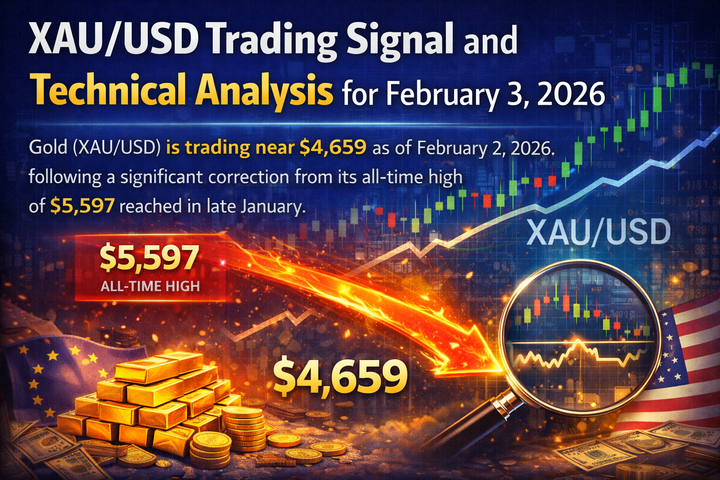
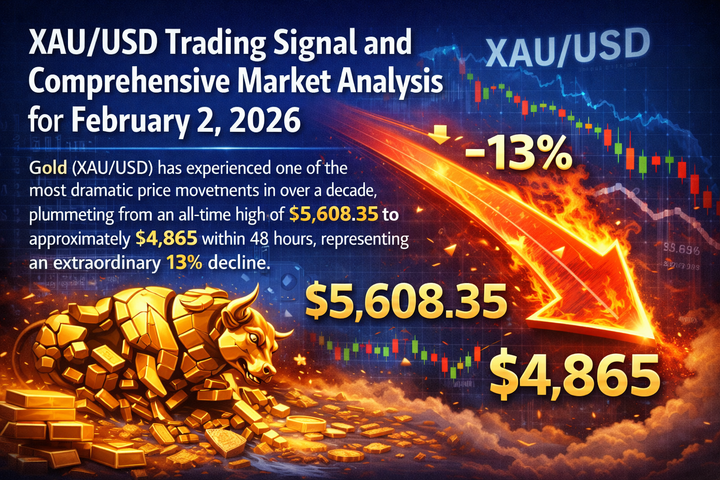
Gold prices rose to $4,899.13 per troy ounce on February 3, 2026, representing a 5.13% gain from the previous trading session. This remarkable surge reflects a 10.18% increase over the past month and an extraordinary 72.45% gain compared to the same period last year. The precious metal remains in proximity to all-time highs, with recent trading activity establishing new records around the $5,450-$5,550 range.
The momentum-driven rally has been fueled primarily by persistent U.S. dollar weakness and heightened economic and geopolitical uncertainty. The U.S. Dollar Index (DXY) declined to 97.6176 on February 3, 2026, down 0.01% from the previous session and weakening 9.58% over the past twelve months. This substantial dollar depreciation has created a favorable environment for dollar-denominated commodities, particularly gold.
Fundamental Analysis: The Pillars Supporting Gold's Rally
Federal Reserve Policy and Interest Rate Environment
The Federal Reserve maintained the federal funds rate at the 3.5%-3.75% target range during its January 2026 meeting, pausing its easing cycle after three consecutive rate cuts in late 2025. This decision aligned with market expectations, though notably, two Federal Reserve governors dissented in favor of an additional 25-basis-point cut. The split decision signals ongoing debate within the Federal Open Market Committee regarding the appropriate pace of monetary policy normalization.
The current interest rate environment remains supportive of gold prices for several reasons. Real interest rates—adjusted for inflation—remain relatively low by historical standards, reducing the opportunity cost of holding non-yielding assets like gold. Market participants anticipate that rates will drift toward 3.25%-3.50% by year-end 2026, suggesting a continuation of accommodative monetary conditions.
U.S. Dollar Weakness: A Primary Catalyst
The U.S. Dollar Index has experienced a significant decline from its late-2025 highs, falling approximately 4% and returning to the critical 96-97 support zone. This support level has historically served as a strong floor for dollar bulls, making the current price action particularly significant for cross-asset market dynamics.
President Trump's recent remarks regarding the dollar's decline to near four-year lows have been interpreted by markets as signaling acceptance of a weaker currency amid ongoing tariff threats and renewed criticism of Federal Reserve independence. This political positioning has reinforced expectations for continued dollar weakness, providing sustained tailwinds for gold prices.
The dollar's weakness extends beyond short-term technical factors. Structural concerns about U.S. fiscal sustainability, expanding budget deficits, and geopolitical realignments are prompting global reserve managers to diversify away from dollar-denominated assets. This fundamental shift in reserve management strategies supports long-term bullish sentiment for alternative reserve assets, particularly gold.
Central Bank Gold Accumulation: Unprecedented Demand
Central bank gold purchases represent one of the most compelling fundamental drivers supporting current price levels. Official sector demand reached 53 tonnes in October 2025, marking a 36% month-over-month surge and the strongest monthly net demand of the year. Year-to-date central bank purchases through October totaled approximately 687 tonnes, maintaining robust demand despite record-high gold prices.
Survey data from the World Gold Council reveals that 95% of central banks plan to increase their gold reserves over the next twelve months, with projected purchases around 755 tonnes for 2026. This represents a structural, long-term trend rather than short-term opportunistic buying. Emerging market central banks continue to lead this accumulation, with Poland, Brazil, and China maintaining dominant positions.
The strategic rationale for continued central bank buying remains compelling. Reserve managers cite gold's role as a hedge against foreign exchange volatility, protection against geopolitical uncertainty, and portfolio diversification benefits. The Central Bank of Kenya recently announced it is "actively considering" adding gold to its reserves as part of a strategy to reduce reliance on U.S. dollar-denominated assets.
Geopolitical Risk Premium
Geopolitical tensions have provided additional support for gold's safe-haven premium in recent weeks. Rising security concerns, regional conflicts, and potential disruptions to international relations have temporarily boosted safe-haven demand. While specific geopolitical events may have limited individual impact, the cumulative effect of ongoing global uncertainty maintains elevated risk premiums in precious metals markets.
The tail risks from geopolitical developments should not be underestimated. Regional conflicts could influence broader international relations, including dynamics between major powers, potentially affecting the global political landscape and offering ongoing support for gold as a neutral reserve asset.
Technical Analysis: Reading the Price Action
Key Technical Indicators
Current technical indicators present a mixed but predominantly bullish picture, with important cautionary signals regarding short-term overbought conditions:
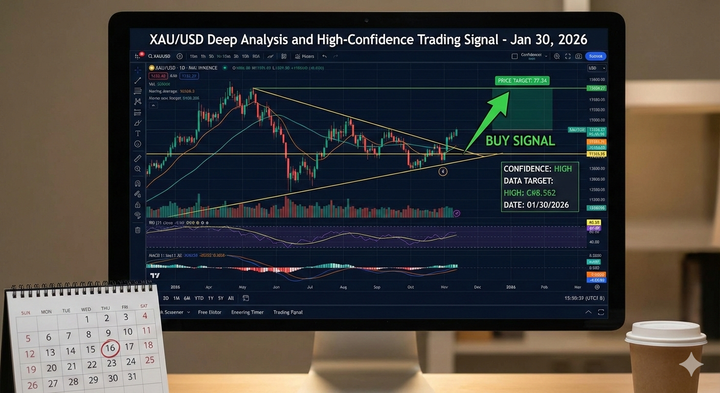
Relative Strength Index (RSI): The 14-period RSI currently reads 93.19, indicating severely overbought conditions. RSI readings above 70 traditionally signal overbought territory, while levels above 90 suggest extreme momentum that often precedes corrections or consolidation periods. However, in strong trending markets, RSI can remain elevated for extended periods before meaningful reversals occur.
Moving Average Convergence Divergence (MACD): The MACD indicator shows a bullish reading at 4,050.59. The MACD remains in positive territory, confirming upward momentum, though the specific reading suggests the need to monitor for potential bearish divergences where price makes new highs while MACD fails to confirm.
Stochastic Oscillator: The Stochastic indicator registers 98.00, signaling overbought conditions and increasing the probability of a short-term pause or retracement. When combined with elevated RSI readings, dual overbought signals strengthen the case for cautious position management.
Moving Averages: Simple Moving Average (SMA) indicators across multiple timeframes (20-period, 50-period, and 100-period) currently generate "Sell" signals. This apparent contradiction with the bullish price action reflects the sharp recent corrections that have temporarily positioned prices below certain moving average references, creating technical resistance levels that must be overcome to confirm trend continuation.
Support and Resistance Levels
Understanding critical support and resistance zones is essential for effective trade management on February 4, 2026:
Key Resistance Levels:
- $5,000: Psychological resistance and previous consolidation zone
- $5,205: Critical breakout level that would confirm upward trend continuation
- $5,450-$5,550: All-time high range and extended target zone
- $5,975: Longer-term bullish target if momentum sustains
Critical Support Levels:
- $5,200-$5,150: Nearest support zone; holding above this area preserves bullish base case
- $4,900-$4,850: Intermediate support corresponding to recent consolidation
- $4,575: Major support level and potential bearish correction target
- $4,550: Extended support; break below would signal deeper correction
- $4,306: Daily S1 support
- $4,155: Critical breakdown level that would invalidate bullish scenario
Chart Pattern Analysis
Gold maintains a strong bullish momentum structure on daily and weekly timeframes. Prices continue setting higher highs, while corrections remain shallow and are quickly reversed, characteristic of momentum-driven rally phases. The precious metal is trading above the middle Bollinger Band and moving along the upper boundary, confirming sustained upward pressure.
Recent price action has witnessed gold breaking short-term bullish trend lines during corrections, creating temporary bearish technical signals. However, these breaks have been accompanied by positive overlapping signals on relative strength indicators after reaching oversold levels, paving the way for rebounds that ease the extent of losses.
The market structure suggests gold is operating in a strong uptrend environment where dip-buying remains the preferred strategy among institutional participants. Most pullbacks have proven shallow and short-lived, with buyers consistently entering at perceived value levels.
Economic Calendar Events for February 4, 2026
Tomorrow's economic calendar includes several high-impact data releases that could significantly influence gold price action:
ADP Employment Report (8:15 AM EST)
The ADP Employment Report for January will provide the first major labor market indicator of the week. This private-sector employment data often serves as a preview for the official Non-Farm Payrolls report scheduled for February 6. Stronger-than-expected employment growth could temporarily strengthen the dollar and pressure gold prices, while weaker data would reinforce expectations for continued Federal Reserve accommodation and support precious metals.
ISM Non-Manufacturing Composite (10:00 AM EST)
The ISM Non-Manufacturing (Services) Index for January represents a crucial gauge of economic activity in the dominant service sector. This indicator provides insights into business conditions, employment trends, and price pressures. Readings above 50 indicate expansion, while below 50 signals contraction. Given services sector employment represents approximately 80% of the U.S. economy, significant deviations from expectations could trigger substantial market volatility.
A weaker ISM reading would support the case for Federal Reserve rate cuts and likely boost gold prices, while a surprisingly strong reading could prompt temporary profit-taking in precious metals positions.
Eurozone CPI (5:00 AM EST)
Preliminary Eurozone Consumer Price Index data for January will be released early in the trading session. European inflation trends influence European Central Bank policy expectations and impact cross-currency dynamics between the euro and dollar. Unexpectedly high inflation could strengthen the euro against the dollar, indirectly supporting gold prices denominated in U.S. currency.
Trading Strategy and Risk Management
Optimal Entry Strategy
Given the technical overbought conditions combined with strong fundamental support, a disciplined entry approach is essential:
Strategy 1: Correction Entry (Preferred)
Wait for intraday pullbacks toward the $4,850-$4,900 zone to establish long positions. This approach offers superior risk-reward ratios and allows entry near key support levels where institutional buying typically emerges. Set alerts at $4,900 and monitor price action for signs of support confirmation such as bullish candlestick patterns or volume surges.
Strategy 2: Breakout Confirmation (Aggressive)
For traders with higher risk tolerance, consider entries on confirmed breakouts above $5,000 with strong volume confirmation. A decisive move above this psychological level could trigger momentum-driven buying and algorithm-driven orders, potentially accelerating the move toward $5,200-$5,250. Breakout trades require tighter stop losses and more active management due to increased risk of false breakouts.
Strategy 3: Scaled Entry (Conservative)
Divide capital into three equal portions and establish positions at $4,900, $4,850, and $4,800. This approach reduces timing risk and ensures participation if the correction extends deeper than initially anticipated. Average entry prices will be more favorable, and partial position building limits exposure to potential overnight gaps.
Position Sizing and Leverage Considerations
Gold's elevated volatility in current market conditions demands careful position sizing. Consider limiting individual trade exposure to 1-2% of total trading capital for conservative accounts and 2-3% for moderate risk tolerance. Given gold's recent daily price swings of 2-5%, excessive leverage could result in premature stop-outs even when directional bias proves correct.
For leveraged accounts, consider reducing standard leverage ratios by 30-40% to account for heightened volatility. A position that might typically employ 10:1 leverage should be limited to 6:1 or 7:1 in current conditions.
Stop Loss Placement
Conservative traders should place stop losses below the $4,750 level, which represents a key structural support zone. This placement protects against deeper corrections while allowing reasonable breathing room for normal intraday volatility.
Moderate risk traders might place stops below $4,550, accepting larger potential losses in exchange for greater probability that positions remain intact during temporary corrections. This wider stop loss accommodates the recent volatility patterns observed in gold markets.
Consider using trailing stops once positions move into profit. A trailing stop of $100-$150 below the highest achieved price allows profits to run while protecting against sudden reversals.
Profit-Taking Strategy
Implement a systematic profit-taking approach to maximize returns while managing risk:
First Target ($5,050-$5,100): Close 30-40% of position to secure initial profits and reduce emotional attachment to the trade. Move stop loss to breakeven on remaining position.
Second Target ($5,200-$5,250): Close additional 30-40% of position as gold approaches major resistance zones. Trail stops aggressively on remaining position.
Extended Target ($5,450-$5,550): Allow final 20-30% of position to capture extended moves if momentum continues. This portion targets all-time highs and represents the "let winners run" component of the strategy.
Scenario Analysis
Bullish Scenario (Probability: 65%)
Gold consolidates briefly in the $4,850-$5,000 range during the European and early U.S. sessions, then rallies following supportive economic data or dollar weakness. The precious metal breaks decisively above $5,000, triggering momentum buying and algorithm-driven orders. Price accelerates toward $5,200-$5,250, potentially testing all-time highs near $5,450-$5,550 if momentum sustains.
Catalysts: Weaker-than-expected ADP employment data, dovish Federal Reserve commentary, continued dollar weakness, geopolitical developments supporting safe-haven demand.
Trading Approach: Enter on initial pullbacks, add on breakout confirmation above $5,000, trail stops aggressively, take partial profits at resistance levels.
Neutral Scenario (Probability: 20%)
Gold trades in a choppy range between $4,800 and $5,000 as markets digest recent gains and await clearer directional signals. Economic data produces mixed results, preventing clear directional bias. The precious metal fails to break decisively above $5,000 but maintains support above $4,800, suggesting consolidation before the next major move.
Catalysts: Mixed economic data, low trading volumes, absence of major catalysts, profit-taking by short-term traders.
Trading Approach: Avoid new positions or trade range-bound strategies (sell near $5,000, buy near $4,850). Wait for clearer directional signals before committing capital.
Bearish Scenario (Probability: 15%)
Gold experiences a deeper correction as profit-taking accelerates following overbought technical readings. Stronger-than-expected economic data strengthens the dollar and reduces immediate Federal Reserve easing expectations. The precious metal breaks below $4,800, triggering stop losses and accelerating the decline toward $4,550-$4,575.
Catalysts: Strong ADP employment report, surprisingly robust ISM data, dollar strength, technical breakdown below key support levels.
Trading Approach: Avoid new long positions, consider defensive strategies, wait for stabilization signals before re-entering, potentially establish short positions if break below $4,750 is confirmed with strong volume.
Multi-Timeframe Analysis
Weekly Perspective
The weekly chart shows gold in a clear uptrend with sustained higher highs and higher lows throughout the past several months. The longer-term structure remains bullish as long as prices hold above the $5,200-$5,150 support zone. Weekly momentum indicators suggest the uptrend has further room to develop, though overbought conditions increase the probability of consolidation phases.
Daily Perspective
Daily charts display a momentum-driven rally phase with corrections remaining shallow and quickly reversed. The bullish channel structure remains intact despite recent volatility. Daily moving averages continue to slope upward, confirming the predominant trend direction. However, extremely overbought oscillators suggest prudent risk management and selective entry points rather than chasing breakouts.
4-Hour and 1-Hour Perspective
Shorter timeframes reveal increased volatility with larger intraday ranges. The 4-hour chart shows gold respecting the $4,850-$4,900 support zone during recent pullbacks, confirming this level as a key demand area. The 1-hour chart displays choppy price action characteristic of consolidation periods, with clear support at $4,850 and resistance near $5,000.
Alternative Technical Methodologies
Fibonacci Analysis
Applying Fibonacci retracement levels to the recent rally from $4,550 to $5,550 provides additional reference points:
- 23.6% retracement: $5,314
- 38.2% retracement: $5,168
- 50.0% retracement: $5,050
- 61.8% retracement: $4,932
The 50% retracement level at $5,050 represents a critical zone that combines Fibonacci support with psychological significance. The 61.8% retracement at $4,932 aligns closely with our recommended entry zone around $4,900, reinforcing this level as a high-probability support area.
Volume Profile Analysis
Volume profile analysis reveals heaviest trading activity occurred in the $4,700-$4,900 range during recent sessions. This zone represents a high-volume node where significant buying and selling occurred, typically providing support during pullbacks. A return to this area would likely attract buyers who missed earlier entries or seek better risk-reward ratios.
Elliott Wave Considerations
From an Elliott Wave perspective, gold appears to be in the latter stages of Wave 3 of a larger impulsive sequence, potentially approaching Wave 4 consolidation. Wave 3 extensions often exceed 161.8% of Wave 1, which would project targets near $5,400-$5,600. A corrective Wave 4 would typically retrace 38.2% to 50% of Wave 3, suggesting pullbacks toward $4,900-$5,000 represent natural correction zones within an ongoing bull trend.
Correlation Analysis and Intermarket Relationships
Gold and the U.S. Dollar
The inverse correlation between gold and the U.S. Dollar Index remains strong at approximately -0.75, indicating that dollar movements explain roughly 75% of gold's directional bias. With the DXY testing critical support at 96-97, the direction of the dollar's next move will significantly influence gold's trajectory.
If the dollar breaks decisively below 96, the path opens for a continued decline toward 94-95, which would provide substantial tailwinds for gold. Conversely, a dollar recovery above 101-102 would create significant headwinds for precious metals.
Gold and Real Interest Rates
Real interest rates (nominal rates minus inflation expectations) remain the most significant fundamental driver of gold prices over medium to long-term periods. Current real rates remain moderately negative to neutral, creating a supportive environment for non-yielding assets. If inflation expectations increase or nominal rates decline further, increasingly negative real rates would provide additional support for gold prices.
Gold and Equity Market Risk Sentiment
During periods of equity market stress, gold typically benefits from safe-haven flows. Monitoring the VIX (volatility index) and equity market behavior provides valuable context for gold trading decisions. Rising equity volatility combined with declining stock prices typically correlates with stronger gold performance as investors seek portfolio protection.
Special Considerations for February 4, 2026
Pre-NFP Positioning
With the crucial Non-Farm Payrolls report scheduled for February 6, traders typically reduce risk exposure ahead of this high-impact event. This positioning behavior could result in profit-taking pressure on February 4, particularly if gold approaches resistance levels. Consider taking partial profits ahead of major data releases and re-establishing positions after volatility subsides.
Month-Beginning Flows
The beginning of February may bring portfolio rebalancing flows from institutional investors adjusting allocations based on January performance. Given gold's exceptional January performance (+10.18% for the month), some rebalancing could involve profit-taking as funds return to target allocations.
Technical Algorithm Behavior
Algorithm-driven trading systems dominate modern gold markets, particularly in futures contracts. These systems typically use technical breakout signals, moving average crossovers, and momentum indicators to generate orders. Awareness of key technical levels ($5,000, $5,200, $4,800) where algorithms likely have orders clustered can improve trade timing and execution.
Advanced Trading Techniques
Options Strategies
For traders with options market access, consider implementing strategies that profit from high volatility while limiting downside risk:
Bull Call Spread: Buy at-the-money calls and sell out-of-the-money calls to reduce premium costs while maintaining upside exposure. This strategy profits if gold rises moderately while limiting maximum risk to the net premium paid.
Protective Collar: For existing long gold positions, consider selling out-of-the-money calls to finance the purchase of out-of-the-money puts. This zero-cost or low-cost strategy protects against significant declines while capping upside participation.
Pairs Trading Opportunities
Consider gold/silver ratio analysis to identify relative value opportunities. The gold/silver ratio currently stands near historically elevated levels, suggesting silver may offer superior relative performance if precious metals rally continues. A pairs trade involving long silver and short gold (or simply overweighting silver) could capture this relationship.
Risk Warnings and Disclaimer
Gold trading involves substantial risk of loss and is not suitable for all investors. The high degree of leverage available in precious metals markets can work against traders as well as for them. Before deciding to trade gold, carefully consider investment objectives, experience level, and risk appetite. Do not invest money you cannot afford to lose.
Past performance is not indicative of future results. The analysis provided is for educational purposes only and does not constitute financial advice. Market conditions can change rapidly, and technical and fundamental analysis may quickly become outdated. Conduct independent research and consult qualified financial advisors before making trading decisions.
Conclusion and Trading Recommendations
Gold presents a cautiously bullish outlook for February 4, 2026, supported by compelling fundamentals including dollar weakness, accommodative Federal Reserve policy, unprecedented central bank buying, and geopolitical uncertainty. However, severely overbought technical conditions require disciplined entry timing and robust risk management.
The optimal trading approach involves waiting for intraday corrections toward $4,850-$4,900 before establishing long positions with defined profit targets at $5,050-$5,100, $5,200-$5,250, and $5,450-$5,550. Stop losses should be positioned below $4,750 for conservative traders or $4,550 for those accepting wider risk parameters.
Economic data releases at 8:15 AM (ADP Employment) and 10:00 AM (ISM Non-Manufacturing) will likely create significant volatility and may provide favorable entry opportunities if initial reactions prove excessive. Monitor dollar behavior closely, as DXY movements around the critical 96-97 support zone will significantly influence gold's directional bias.
The confluence of fundamental support and technical momentum suggests higher prices remain the path of least resistance, though short-term consolidation or correction would represent healthy price action rather than trend reversal. Maintain disciplined risk management, avoid overleveraging, and scale into positions rather than committing full capital at single price points.
For traders unable to actively monitor markets during U.S. trading hours, consider placing limit orders at key support levels with predetermined stop losses and profit targets. This approach ensures participation while protecting against emotional decision-making during volatile price action.
Final Signal Summary:
- Direction: Bullish with consolidation risk
- Entry: $4,850-$4,900 (primary), $4,775-$4,825 (aggressive)
- Targets: $5,050-$5,100 (T1), $5,200-$5,250 (T2), $5,450-$5,550 (T3)
- Stop Loss: Below $4,750 (conservative), below $4,550 (moderate)
- Confidence: 75% upside probability
- Time Horizon: 1-3 trading days for initial targets
Key Monitoring Points:
- U.S. Dollar Index behavior at 96-97 support
- ADP Employment Report (8:15 AM EST)
- ISM Non-Manufacturing Index (10:00 AM EST)
- Technical behavior at $5,000 psychological resistance
- RSI divergences indicating momentum exhaustion
By combining rigorous fundamental analysis, comprehensive technical evaluation, and disciplined risk management, traders can navigate gold's volatile but potentially rewarding market conditions on February 4, 2026.
Comments ()