USD/CAD and Oil: How to Build a Clean Correlation Framework
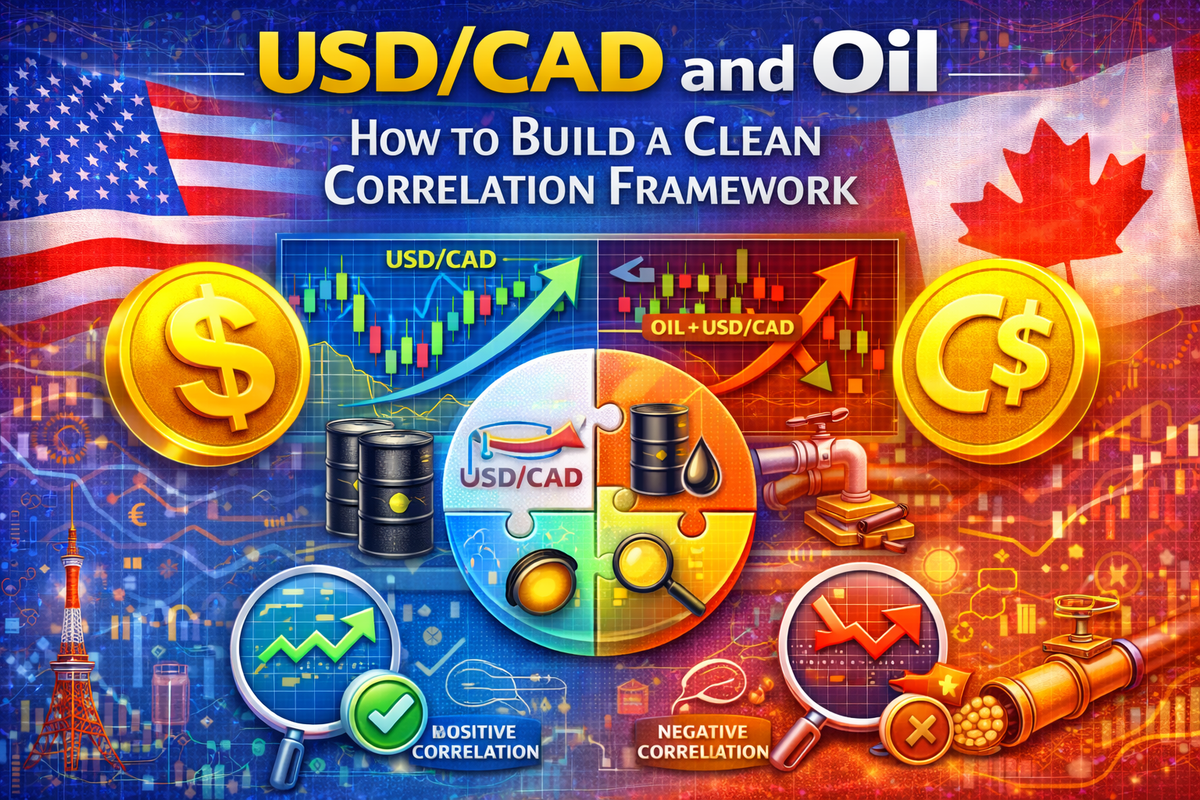
The relationship between the Canadian dollar and crude oil prices represents one of the most reliable correlations in global financial markets. Understanding and properly implementing a correlation framework for USD/CAD and oil can provide traders and investors with powerful insights for risk management, portfolio diversification, and trading opportunities. This comprehensive guide explores the mechanics of this relationship and provides a systematic approach to building a robust correlation framework.
Understanding the USD/CAD and Oil Correlation
The Economic Foundation
Canada stands as one of the world's largest oil exporters, with crude oil accounting for a substantial portion of the country's foreign exchange earnings. The nation exports approximately 2 million barrels of oil to the United States daily, with 85% of all Canadian exports destined for the U.S. market. This heavy dependence on oil exports creates a direct economic link between oil prices and the Canadian dollar's value.
When oil prices rise, Canada earns more revenue from exports, strengthening the domestic economy and increasing investor demand for the Canadian dollar. In the USD/CAD currency pair—where USD serves as the base currency—a stronger CAD causes the pair's price to fall. Conversely, declining oil prices reduce demand for CAD, weakening the currency and pushing USD/CAD higher.
Quantifying the Relationship
Historical data reveals a strong negative correlation between USD/CAD and crude oil prices, typically ranging between -0.80 and -0.93. This negative correlation means that when oil prices increase, USD/CAD tends to decrease, and vice versa. From the perspective of CAD/USD (the inverted pair), there exists a positive correlation of approximately 0.75 to 0.80 with oil prices.
The correlation coefficient, which ranges from -1 to +1, provides a quantitative measure of this relationship. A coefficient of -0.89 indicates that roughly 79% of the variance in USD/CAD movements can be explained by changes in oil prices, making this one of the most predictable forex-commodity relationships in the market.
Building Your Correlation Framework
Step 1: Data Collection and Preparation
The foundation of any correlation framework begins with high-quality, consistent data. For a USD/CAD and oil correlation analysis, you need:
Price Data Requirements
- Daily closing prices for USD/CAD from your chosen timeframe
- Daily closing prices for WTI (West Texas Intermediate) or Brent crude oil
- Minimum dataset of 250 trading days for meaningful statistical analysis
- Synchronized data points ensuring both markets were open on the same days
Data Sources
- Central bank databases for currency exchange rates
- Energy Information Administration (EIA) for oil prices
- Financial data providers offering historical forex and commodity data
- Trading platforms with built-in correlation analysis tools
Step 2: Calculate Returns
Converting price data into returns provides a more statistically appropriate measure for correlation analysis. Calculate logarithmic returns using the following approach:
Logarithmic Returns Formula
For each asset, compute the natural logarithm of the price ratio between consecutive periods. This method normalizes the data and accounts for compounding effects, making correlations more reliable across different price levels.
Returns-based analysis captures the percentage change in asset values rather than absolute price movements, providing a standardized measure that remains consistent whether oil trades at $50 or $100 per barrel.
Step 3: Correlation Coefficient Calculation
The correlation coefficient serves as the primary metric in your framework. Several calculation methods exist, each with specific applications:
Pearson Correlation Coefficient
The standard measure of linear correlation between two continuous variables. This coefficient works well for USD/CAD and oil due to their relatively consistent linear relationship. Calculate this coefficient over your entire dataset to establish the baseline correlation strength.
Rolling Correlation Analysis
Rather than calculating a single static correlation, rolling correlation provides dynamic insights into how the relationship changes over time. Select a rolling window (commonly 30, 60, or 90 days) and calculate the correlation coefficient for each consecutive window period.
For example, using a 30-day window with daily data, calculate the correlation for days 1-30, then days 2-31, then days 3-32, and so on. This generates a time series of correlation values, revealing when the relationship strengthens or weakens.
Step 4: Implement Dynamic Conditional Correlation (DCC-GARCH) Models
For advanced practitioners, the DCC-GARCH (Dynamic Conditional Correlation - Generalized Autoregressive Conditional Heteroskedasticity) model represents the gold standard for correlation analysis in financial markets.
Why DCC-GARCH Matters
Traditional correlation measures assume constant relationships over time, but financial market correlations are inherently time-varying. The DCC-GARCH model addresses this limitation by:
- Modeling conditional variances separately for each asset
- Estimating dynamic correlations that evolve based on recent market conditions
- Capturing volatility clustering and conditional heteroskedasticity
- Providing more accurate forecasts during periods of market stress
Implementation Framework
The DCC-GARCH process consists of two main stages:
- Univariate GARCH Estimation: Model the conditional variance for each asset (USD/CAD returns and oil returns) independently using GARCH(1,1) specifications
- DCC Estimation: Model the time-varying correlation matrix using standardized residuals from the first stage
The model parameters include α (short-term shock effects) and β (persistence of correlation). When α₁ + β₁ approaches 1, it indicates high persistence in correlation dynamics, meaning shocks to the correlation structure take considerable time to dissipate.
Practical Application
Research demonstrates that DCC-GARCH models successfully capture correlation dynamics during crisis periods when relationships can change dramatically. For USD/CAD and oil, implementing this model allows you to detect when the typical negative correlation strengthens during oil market volatility or weakens during periods when other factors dominate currency movements.
Step 5: Establish Correlation Thresholds
Effective trading frameworks require clear decision rules based on correlation strength. Establish thresholds that trigger specific actions:
Threshold Categories
- Strong Correlation (|r| > 0.7): High confidence in the relationship; suitable for direct correlation trading strategies
- Moderate Correlation (0.5 < |r| < 0.7): Relationship present but less reliable; requires confirmation from other indicators
- Weak Correlation (|r| < 0.5): Unreliable relationship; avoid correlation-based strategies
For USD/CAD and oil, the historical correlation typically exceeds -0.75, placing it firmly in the strong correlation category. However, monitoring when correlations fall below these thresholds provides valuable risk management signals.
Step 6: Identify Correlation Breakdowns
Correlation breakdowns represent periods when the expected relationship between USD/CAD and oil temporarily fails. These breakdowns create both risks and opportunities:
Common Causes of Breakdown
- Central bank interventions or unexpected monetary policy decisions
- Major geopolitical events affecting currency markets independently of oil
- Significant changes in U.S. economic data that strengthen or weaken the USD broadly
- Structural shifts in Canada's oil production or export patterns
Detection Methods
Monitor rolling correlation values and establish alert thresholds. When the 30-day rolling correlation moves above -0.50 (less negative than usual), this signals a potential breakdown requiring investigation. Similarly, if the correlation strengthens beyond -0.95, it may indicate excessive market stress.
Trading Strategies Based on Correlation Framework
Direct Correlation Trading
Direct correlation trading exploits the reliable inverse relationship between USD/CAD and oil prices. When oil prices rise sharply, traders can anticipate downward pressure on USD/CAD and position accordingly.
Entry Signals
- Confirm strong negative correlation (r < -0.70) over recent rolling window
- Identify significant oil price movement (>2% daily change)
- Verify that USD/CAD has not yet fully adjusted to the oil price move
- Enter USD/CAD position in the direction opposite to the oil move
Risk Management
- Position size based on correlation strength; smaller positions when correlation weakens
- Implement correlation-based stop losses that trigger when the relationship deviates significantly from expectations
- Monitor for fundamental factors that might disrupt the typical correlation pattern
Hedging Strategies
The strong USD/CAD-oil correlation provides natural hedging opportunities for portfolio managers. Energy companies with Canadian dollar exposure can use USD/CAD positions to hedge oil price risk, while currency-focused portfolios can use oil futures to hedge CAD exposure.
Hedge Ratio Calculation
The optimal hedge ratio depends on the correlation coefficient and the volatility of each asset. A simplified approach uses the correlation coefficient multiplied by the ratio of standard deviations. For example, if USD/CAD has volatility of 8% and oil has volatility of 30%, with correlation of -0.85, the hedge ratio would be approximately -0.23, meaning a hedger would use $0.23 of USD/CAD position for every $1 of oil exposure.
Divergence Trading
Divergence strategies capitalize on temporary deviations from the expected correlation. When oil prices and USD/CAD move in unexpected directions relative to their historical relationship, traders can position for mean reversion.
Setup Requirements
- Establish the "fair value" USD/CAD level based on current oil prices and historical regression
- Calculate the standard deviation of deviations from fair value
- Enter mean reversion trades when actual USD/CAD deviates by more than 1.5 standard deviations from fair value
- Exit when the relationship returns to within 0.5 standard deviations of normal
Advanced Framework Considerations
Multi-Timeframe Analysis
Correlation relationships often vary across different timeframes. The USD/CAD-oil correlation typically strengthens over longer timeframes (monthly, quarterly) as short-term noise diminishes and fundamental economic relationships dominate.
Implement a multi-timeframe approach:
- Short-term (daily): Higher volatility in correlation; useful for tactical trading
- Medium-term (weekly): More stable correlation; better for swing trading strategies
- Long-term (monthly): Most reliable correlation; suitable for hedging and portfolio allocation
Volatility Adjustments
During periods of high market volatility, correlations between financial assets tend to increase. For USD/CAD and oil, this often manifests as strengthening negative correlation during oil market crises or major geopolitical events affecting energy markets.
Adjust your framework by:
- Implementing volatility-scaled correlation measures that account for changing market conditions
- Increasing minimum correlation thresholds during high-volatility periods
- Reducing position sizes when volatility exceeds historical norms
Regime Detection
Financial markets operate in different regimes with distinct correlation characteristics. For USD/CAD and oil, key regimes include:
Normal Market Conditions
Correlation typically ranges from -0.80 to -0.90, with oil price changes leading USD/CAD adjustments by several hours or days.
Oil Crisis Periods
Correlation often strengthens beyond -0.92 as oil price movements dominate all other factors affecting the Canadian dollar.
USD Dominance Periods
When broad U.S. dollar strength or weakness becomes the primary market driver, the USD/CAD-oil correlation may temporarily weaken as the USD factor affects all currency pairs simultaneously.
Implement regime detection using statistical tests or machine learning algorithms to identify regime shifts and automatically adjust correlation parameters.
Risk Management Within the Framework
Position Sizing Based on Correlation Strength
Dynamically adjust position sizes based on current correlation readings. When correlation weakens from typical levels, reduce exposure to correlation-based trades proportionally.
Example Framework
- At correlation of -0.85 or stronger: 100% of normal position size
- At correlation between -0.70 and -0.85: 60% of normal position size
- At correlation weaker than -0.70: 25% of normal position size or avoid correlation trades entirely
Portfolio Diversification Implications
The strong USD/CAD-oil correlation has important implications for portfolio construction. Holding both long oil positions and long CAD positions (short USD/CAD) creates concentrated exposure rather than diversification, as both positions benefit from the same fundamental driver.
True diversification requires:
- Limiting combined exposure to correlated assets
- Understanding that correlation-based hedges may fail during market stress
- Incorporating assets with low or negative correlation to both oil and USD/CAD
Monitoring Inflation Dynamics
Oil price movements influence inflation rates, which in turn affect monetary policy and currency values. When oil prices rise significantly, inflationary pressures may prompt the Bank of Canada to adjust interest rates, creating a secondary effect on the Canadian dollar beyond the direct trade balance impact.
Incorporate inflation monitoring into your framework by:
- Tracking Canadian Consumer Price Index (CPI) data, particularly energy components
- Analyzing Bank of Canada communications regarding inflation concerns
- Adjusting correlation expectations during periods of high inflation volatility
Practical Implementation Example
Consider a practical scenario demonstrating framework application:
Market Conditions
- Current WTI crude oil price: $75 per barrel
- Current USD/CAD: 1.3500
- 30-day rolling correlation: -0.88
- 90-day rolling correlation: -0.85
Oil Price Movement
Oil prices surge to $82 per barrel (9.3% increase) over three trading days due to supply disruptions.
Framework Analysis
- Correlation Check: Both 30-day and 90-day correlations exceed -0.80, confirming strong relationship
- Expected USD/CAD Impact: Historical regression suggests USD/CAD should decline by approximately 600-700 pips (0.0600-0.0700) for a $7 oil price increase
- Actual Movement: USD/CAD trades at 1.3480, representing only a 20-pip decline
- Deviation Analysis: USD/CAD is approximately 500 pips (0.0500) higher than correlation suggests it should be
Trading Decision
This represents a significant deviation from the expected relationship, suggesting USD/CAD remains overvalued relative to oil. The framework signals a short USD/CAD opportunity with:
- Entry: 1.3480
- Target: 1.3420 (accounting for 60% reversion to correlation expectation)
- Stop loss: 1.3520 (above recent high and beyond reasonable correlation deviation)
- Position size: Standard size given strong correlation readings
Maintaining and Updating Your Framework
Regular Calibration
Correlation relationships evolve over time as economic structures change. Canada's economy has diversified beyond oil in recent decades, potentially weakening the long-term correlation. Regular recalibration ensures your framework remains current:
- Monthly Reviews: Recalculate baseline correlation statistics using updated data
- Quarterly Analysis: Assess whether correlation thresholds require adjustment
- Annual Evaluation: Conduct comprehensive framework review, including structural changes in the Canadian economy or oil markets
Technology and Automation
Modern trading platforms and programming languages enable automated correlation monitoring. Implementing automated systems provides:
- Real-time correlation calculation and alert systems
- Automated trade signal generation based on framework rules
- Backtesting capabilities to validate framework performance
- Systematic execution removing emotional decision-making
Python, R, and specialized trading platforms offer libraries specifically designed for correlation analysis and GARCH modeling, making advanced framework implementation accessible to individual traders and institutional managers alike.
Conclusion
Building a clean correlation framework for USD/CAD and oil trading requires systematic data collection, appropriate statistical methods, and clear decision rules. The strong historical relationship between these assets provides reliable trading and hedging opportunities, but only when approached with disciplined methodology.
Success requires understanding both the economic fundamentals driving the correlation and the statistical tools necessary to measure and monitor it effectively. By implementing rolling correlations, DCC-GARCH models, and regime-aware adjustments, traders can capture the relationship's predictive power while managing the risks associated with correlation breakdowns.
The framework outlined in this article provides a comprehensive foundation, but individual traders should customize parameters based on their specific risk tolerance, trading timeframe, and market access. Regular monitoring, disciplined risk management, and continuous framework refinement transform the USD/CAD-oil correlation from an academic observation into a practical trading edge.
Whether deployed for directional trading, portfolio hedging, or risk management, a well-constructed correlation framework represents an essential tool for any serious participant in currency or commodity markets. The remarkable persistence of the USD/CAD-oil relationship over decades suggests this framework will remain relevant for years to come, though vigilant monitoring for structural changes remains imperative.


Comments ()