The Best Times to Trade XAU/USD (And When to Stay Out)
Trading gold against the US dollar (XAU/USD) presents unique opportunities for traders seeking to capitalize on one of the world's most liquid and volatile markets. However, success in gold trading depends not just on strategy and analysis, but critically on timing. Understanding when the market offers optimal conditions—and equally important, when to stay away—can dramatically improve trading performance and preserve capital.
Understanding XAU/USD Market Hours and Structure
XAU/USD trades nearly 24 hours a day, five days a week, opening Sunday at 22:00 GMT with the Sydney session and closing Friday at 22:00 GMT after the New York session ends. This continuous trading cycle moves through four major sessions: Sydney, Tokyo, London, and New York. However, not all hours within this cycle offer equal opportunity.
The market operates across distinct geographical zones, each bringing different levels of liquidity, volatility, and trader participation. During high-activity periods, spreads tighten, execution improves, and price movements become more predictable. Conversely, low-activity windows can produce erratic price action, wider spreads, and false signals that trap unsuspecting traders.
The Golden Window: London-New York Overlap
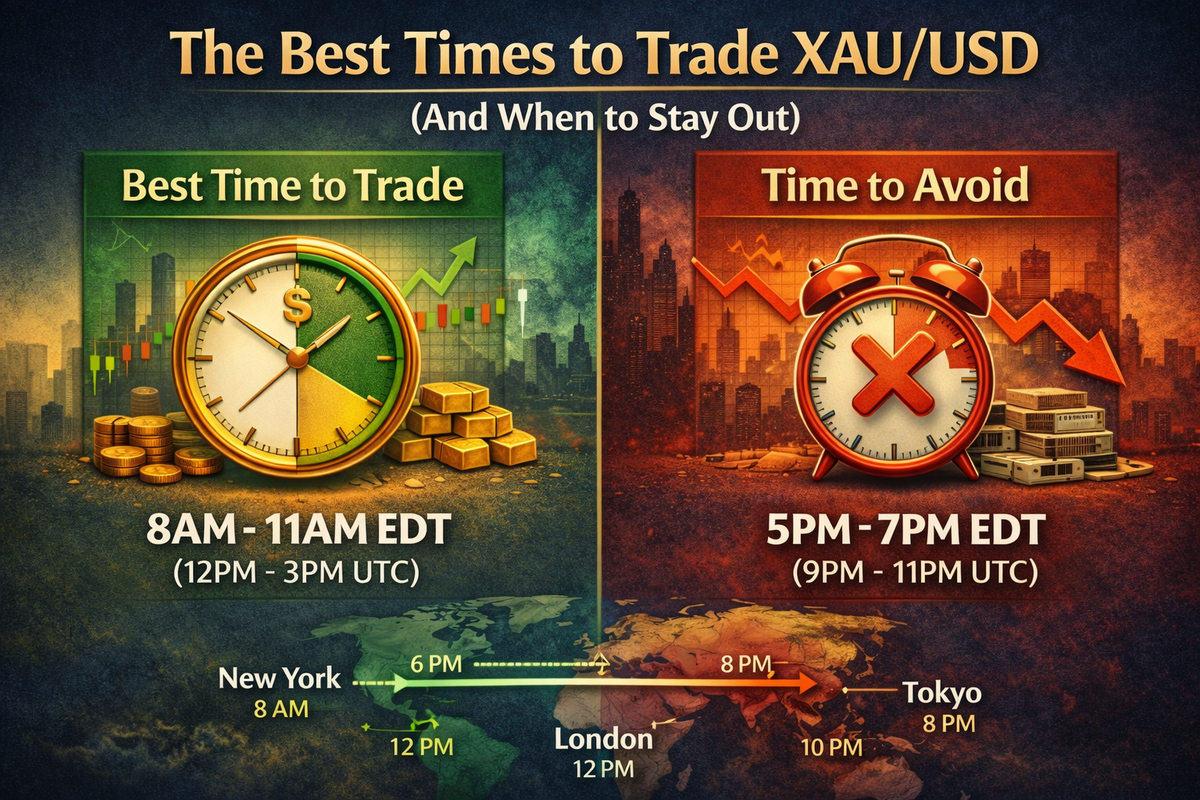
The absolute best time to trade XAU/USD occurs during the London-New York overlap, specifically between 13:00 and 16:00 GMT (8:00 AM to 11:00 AM EST). This three-hour window represents the convergence of the world's two largest financial centers, creating peak liquidity conditions that benefit traders in multiple ways.
Why This Period Dominates
During this overlap, trading volume reaches its highest point of the day as both European and American traders actively participate in the market. Major US economic data releases typically occur at 13:30 GMT (8:30 AM EST), including critical reports such as Nonfarm Payrolls, Consumer Price Index, Federal Reserve announcements, and GDP figures. These releases inject significant volatility into gold prices, as XAU/USD responds strongly to data affecting the US dollar and monetary policy expectations.
The overlap period delivers tighter spreads—often the narrowest of the entire trading day—which reduces transaction costs and improves profit potential. Orders execute faster with minimal slippage, and price movements tend to be more directional rather than choppy. For scalpers, day traders, and swing traders alike, this window provides the most reliable setups and cleanest technical patterns.
Practical Trading During the Overlap
Traders focusing on this session should prepare their watchlists and analysis before the window opens. The COMEX (Commodity Exchange) in New York, where physical gold futures trade, opens at 13:20 GMT, adding another layer of institutional participation. This combination of spot forex liquidity and futures market activity creates strong momentum that technical traders can exploit.
Breakout strategies perform particularly well during this period, as genuine price movements have sufficient volume to follow through. Support and resistance levels become more meaningful when tested during high-liquidity hours, and false breakouts occur less frequently compared to thin-market conditions.
The European Session: Strong but Secondary
The European session, running from 07:00 to 16:00 GMT, represents the second-best opportunity for XAU/USD trading. London, as the world's largest forex trading center, accounts for approximately 43% of global forex volume, making the early European hours particularly active for gold trading.
During this session, volatility increases compared to Asian hours, and new intraday trends often establish themselves. European economic data releases, particularly from the Eurozone and United Kingdom, can move XAU/USD significantly, especially when these reports affect broader risk sentiment or monetary policy expectations.
However, the European session alone lacks the explosive momentum seen during the New York overlap. Price action tends to be more measured, which suits range-trading strategies and position-building for anticipated US session moves. Experienced traders often use European hours to identify key levels and prepare for the higher-volatility period ahead.
The US Session Beyond the Overlap
After the London-New York overlap ends at 16:00 GMT, the US session continues until 22:00 GMT. While still more active than Asian hours, this period experiences gradually declining liquidity as European traders exit the market. Volatility remains elevated, particularly during the first few hours, but price movements can become less predictable as the session progresses.
The early US session (13:00 to 17:00 GMT) remains viable for trading, especially on days with significant US economic releases or Federal Reserve commentary. However, traders should exercise increased caution in the later US hours, particularly after 20:00 GMT, when liquidity begins to thin noticeably.
The Asian Session: Proceed with Caution
The Asian session, running from approximately 00:00 to 09:00 GMT, presents the most challenging conditions for XAU/USD trading. During these hours, liquidity drops significantly, and price action becomes range-bound unless major news emerges from China, Japan, or Australia.
When Asian Hours Matter
Despite generally lower activity, certain Asian session periods warrant attention. Chinese economic data releases, particularly from the People's Bank of China (PBoC), can generate meaningful XAU/USD movements given China's status as the world's largest gold consumer. Similarly, Australian employment data and Reserve Bank of Australia announcements occasionally trigger gold price reactions during Sydney trading hours.
However, these opportunities are the exception rather than the rule. Most Asian session trading sees gold prices consolidate in tight ranges, making it difficult for short-term strategies to generate profits. Range-trading approaches may work during these hours, but the reduced volatility and wider spreads diminish profit potential.
Critical Times to Avoid Trading XAU/USD
Understanding when to stay out of the market is as important as knowing optimal entry times. Several periods consistently present unfavorable conditions that increase risk and reduce profitability.
The Rollover Period
The daily rollover occurs around 22:00 GMT (17:00 EST), marking the transition from one trading day to the next. During this one-to-two-hour window, spreads can widen dramatically—sometimes expanding to 10-20 times their normal levels even on highly liquid instruments.
This spread expansion occurs because liquidity providers temporarily withdraw from the market during the technical rollover process. Traders holding positions through rollover face several risks: stop-loss orders may trigger on artificially wide spreads, slippage increases substantially, and price spikes unrelated to fundamental factors can occur.
Professional traders typically close positions or avoid new entries 10-15 minutes before rollover, particularly if stop-loss levels sit close to current prices. For swing traders holding multi-day positions, ensuring adequate distance between stop-loss orders and current price before rollover helps avoid unnecessary exits.
Late New York to Early Asian Transition
The period from 22:00 to 00:00 GMT represents the day's lowest liquidity, falling between the New York close and Tokyo open. During these hours, spreads widen, price movements become erratic, and false signals proliferate. This window lacks both the institutional participation that drives meaningful trends and the liquidity that ensures fair pricing.
Trading strategies dependent on momentum or news-driven movement fail during this dead zone. Even swing traders should avoid initiating positions during these hours, as entry prices may be significantly disadvantageous compared to more liquid periods.
Major Holidays and Bank Closures
Trading XAU/USD during major holidays in the United States, Europe, or other financial centers creates substantial challenges. When key markets close for holidays like Christmas, New Year's Day, US Thanksgiving, or Easter, liquidity evaporates from the market.
Reduced participation leads to wider spreads, increased slippage, and unpredictable price movements. The cost of executing trades rises substantially, and the risk of stop-hunting increases as thin order books make prices more susceptible to manipulation. Professional traders generally close positions or reduce exposure ahead of major holidays rather than attempting to trade through them.
Friday Afternoons
Friday afternoons, particularly the final hours before the weekly close, present mixed conditions that often favor staying out. While the early New York session on Fridays can be highly active, liquidity typically declines after 19:00 GMT as traders close positions ahead of the weekend.
This end-of-week dynamic creates several risks. Price movements can reverse sharply as profit-taking intensifies, and weekend gap risk encourages position-squaring that may trigger false breakouts. Additionally, spreads begin widening earlier on Fridays compared to other weekdays, increasing transaction costs.
Day-of-Week Patterns in XAU/USD Trading
Gold trading exhibits distinct patterns across the trading week, with certain days consistently offering better opportunities than others.
Monday: The Slow Start
Mondays typically experience lower liquidity and reduced volatility compared to mid-week sessions. Many institutional traders and large market participants have not yet fully engaged, and banks often postpone major decisions until later in the week. This creates a relatively calm market with slower, less reliable price movements.
Historically, Monday ranks as the worst-performing day for gold, with negative Mondays outnumbering positive ones in long-term statistics. While spreads may be reasonable, the lack of strong directional bias makes Monday challenging for momentum-based strategies. Conservative traders often use Mondays for analysis and preparation rather than aggressive position-building.
Tuesday: Increasing Activity
Tuesday marks the beginning of serious market engagement as liquidity increases and institutional participants become more active. Price trends begin to establish themselves more clearly, and trading opportunities improve compared to Monday's sluggish conditions.
This day represents a transition point where the market shakes off weekend inertia and begins responding more predictably to technical levels and fundamental factors. Traders can start implementing more active strategies as market behavior normalizes.
Wednesday: Peak Performance
Wednesday consistently ranks as the best day of the week for XAU/USD trading. Liquidity reaches its highest weekly level, strong trends form more reliably, and important economic data releases frequently occur mid-week. The combination of maximum participation and meaningful catalysts creates excellent trading opportunities.
Both the London-New York overlap and standalone US session deliver strong performance on Wednesdays. Price movements tend to be more directional and sustained, making technical setups more reliable. However, traders must remain vigilant, as excessive volatility on Wednesdays can trigger stop-loss orders during otherwise favorable trends.
Thursday: Sustained Strength with Late Decline
Thursday maintains strong trading conditions through most of the day but may experience liquidity decline during the second half. Some long-term traders begin closing positions ahead of the weekend, which can lead to price corrections and reduced follow-through on intraday moves.
Despite this potential weakening, Thursday generally offers good opportunities, particularly during the London-New York overlap. Traders should remain aware that late-session momentum may prove less reliable than on Wednesday.
Friday: High Volatility, High Risk
Friday presents a paradox for XAU/USD traders. The early New York session often sees high trading volume and significant volatility, creating attractive short-term opportunities. However, as the session progresses, liquidity declines markedly and price swings become increasingly unpredictable.
The combination of position-squaring, weekend gap concerns, and profit-taking creates an environment where false breakouts and reversals occur frequently. While aggressive traders may profit from early-Friday volatility, the increasing risk in afternoon hours often makes selective trading or staying out entirely the prudent choice.
Historically, Friday ranks as one of the more positive days for gold in terms of direction, but the declining liquidity in the latter half significantly increases execution challenges. Weekend headlines can also create gap risk that catches Friday positions off-guard when markets reopen Sunday evening.
Economic Indicators That Move XAU/USD
Understanding which economic releases create the most significant XAU/USD movements helps traders time their market participation around these high-impact events.
US Nonfarm Payrolls (NFP)
Released on the first Friday of each month at 13:30 GMT, the NFP report typically generates the largest single-day volatility in XAU/USD. This employment data directly influences Federal Reserve monetary policy expectations, which in turn affect both the US dollar and gold prices inversely.
Traders should prepare for extreme volatility during and immediately after NFP releases. Spreads widen temporarily, and price can move hundreds of pips within minutes. Many traders avoid holding positions through NFP, while others specifically target this volatility with appropriate risk management.
Federal Reserve Announcements and FOMC Meetings
Federal Open Market Committee (FOMC) meetings and subsequent press conferences create major XAU/USD movements, particularly when interest rate decisions or policy guidance surprise markets. Gold prices respond strongly to monetary policy changes because interest rate differentials affect the opportunity cost of holding non-yielding gold.
FOMC meetings occur eight times per year, typically on Wednesdays, with the policy statement released at 19:00 GMT followed by a press conference. The volatility during these events rivals or exceeds NFP releases.
Consumer Price Index (CPI) and Inflation Data
Monthly CPI releases at 13:30 GMT significantly impact XAU/USD because gold traditionally serves as an inflation hedge. Higher-than-expected inflation often supports gold prices while simultaneously affecting Federal Reserve policy expectations, creating complex price dynamics.
Core CPI, which excludes volatile food and energy prices, frequently generates stronger market reactions than headline CPI because it more directly influences Fed decision-making.
GDP and Growth Indicators
Quarterly GDP releases and monthly indicators like retail sales, industrial production, and consumer confidence affect XAU/USD through their impact on broader risk sentiment and monetary policy expectations. Strong growth typically supports riskier assets over safe-haven gold, while weak growth has the opposite effect.
Monthly and Seasonal Patterns
Beyond daily and weekly patterns, XAU/USD exhibits longer-term seasonal tendencies that informed traders incorporate into their decision-making.
September: Historically Weak
Statistical analysis reveals that September ranks as the worst month for gold performance. Over the past decade, 90% of Septembers closed in negative territory, with similarly poor performance over 15-year and 20-year periods. This consistent weakness suggests seasonal factors—possibly related to Indian festival demand patterns, harvest cycles, or institutional rebalancing—regularly pressure gold prices during this month.
Traders should approach September with defensive strategies, potentially reducing position sizes or focusing on short-side opportunities depending on broader market context.
January: Historically Favorable
Conversely, January historically favors long positions in gold. The new year often brings fresh investment flows, portfolio rebalancing, and renewed interest in precious metals after year-end position-squaring.
While historical patterns don't guarantee future performance, understanding these tendencies provides context for probability-based trading approaches.
Adapting Trading Strategies to Optimal Times
Different trading styles benefit from specific time windows, and matching strategy to market conditions improves consistency.
Scalping Strategies
Scalpers targeting small, frequent profits require the tightest spreads and highest liquidity available. The London-New York overlap provides ideal conditions for scalping XAU/USD, with rapid execution, minimal slippage, and sufficient volatility to generate multiple opportunities per session.
Scalpers should strictly avoid Asian sessions, rollover periods, and late-Friday trading when spread widening and erratic price movement undermine the tight risk control scalping requires.
Day Trading Approaches
Day traders seeking to capture intraday trends perform best during the European session and especially the London-New York overlap. These periods provide the directional momentum and volume necessary for trends to develop and sustain through the trading day.
Day traders can also capitalize on scheduled economic releases, though this requires sophisticated risk management given the explosive volatility these events generate. Most day traders close all positions before the daily rollover to avoid overnight exposure.
Swing Trading Considerations
Swing traders holding positions for multiple days face different timing considerations. Entry timing remains important—initiating positions during high-liquidity periods ensures better pricing—but swing traders can tolerate daily fluctuations that would concern shorter-term traders.
However, swing traders must carefully manage positions around major economic releases and weekend risk. Setting stop-loss orders wide enough to avoid rollover-related spikes while maintaining acceptable risk parameters requires careful calculation.
Risk Management Across Different Time Windows
Effective risk management adjusts to changing market conditions throughout the trading day and week.
Position Sizing Relative to Liquidity
During optimal trading hours (London-New York overlap), tighter spreads and better execution justify normal position sizing based on account risk parameters. However, during lower-liquidity periods, reducing position size compensates for wider spreads and increased slippage that can substantially impact profitability.
A position that risks 1% of account equity during peak hours might effectively risk 1.5-2% during Asian sessions once spread costs and potential slippage are factored in. Adjusting size downward during suboptimal periods maintains consistent risk exposure.
Stop-Loss Placement Around Key Times
Stop-loss orders require special consideration around rollover periods and low-liquidity windows. Placing stops too close to current price during these times invites unnecessary triggering on temporary spread widening unrelated to actual market direction.
Traders should either widen stops appropriately or close positions entirely before problematic periods. The common practice of placing stops 10-15 minutes before rollover helps avoid this issue for positions that will be re-entered after normal conditions resume.
Managing Weekend Gap Risk
Friday afternoon trading requires careful consideration of weekend gap potential. Major geopolitical events, central bank actions, or other significant developments occurring while markets are closed can create substantial price gaps when trading resumes Sunday evening.
Conservative traders close all positions before Friday's close, accepting slightly earlier exits to eliminate weekend risk. More aggressive traders may hold through weekends but typically reduce position sizes to account for gap exposure.
Advanced Considerations: Market Makers and Liquidity
Understanding market microstructure provides additional insight into optimal trading times and why certain periods present challenges.
The Role of Market Makers
Market makers provide bid and offer quotes simultaneously, profiting from the spread between them rather than from directional price movement. Their presence creates liquidity that allows traders to execute orders efficiently. During high-activity periods, numerous market makers compete, tightening spreads and improving execution.
However, during low-liquidity windows, fewer market makers participate, and those remaining widen their spreads to compensate for increased risk. This explains the dramatic spread expansion during rollover and holiday periods.
Stop Hunting Versus Liquidity Seeking
The concept of "stop hunting"—where price briefly moves to trigger stop-loss orders before reversing—is often misunderstood. Large institutional orders require substantial liquidity for execution. Areas where stop-loss orders cluster represent pockets of available liquidity.
When price moves to these levels, it's typically institutions seeking liquidity to fill large orders rather than deliberately targeting retail traders. Understanding this dynamic helps traders recognize that stop-loss placement at obvious technical levels increases triggering probability during volatile periods, regardless of whether the move represents a genuine trend change.
Practical Implementation: Creating a Trading Schedule
Successful XAU/USD trading requires a structured approach to market participation. Traders should develop a schedule that aligns with optimal market hours while respecting personal constraints.
Step 1: Identify Your Available Trading Hours
Determine which market sessions align with your geographic location and personal schedule. A trader in London has natural access to European and overlap sessions, while a Tokyo-based trader must adapt to Asian hours or adjust sleep schedules to access higher-liquidity periods.
Step 2: Focus on Quality Over Quantity
Rather than attempting to trade all available hours, concentrate on the highest-quality time windows. A trader focusing exclusively on the 13:00-16:00 GMT London-New York overlap and avoiding all other periods may outperform someone trading continuously throughout the day.
Step 3: Mark Economic Calendar Events
Maintain an economic calendar highlighting major XAU/USD-moving events: NFP, FOMC, CPI, GDP, and other significant releases. Decide in advance whether to trade through these events, close positions beforehand, or stay out entirely based on strategy and risk tolerance.
Step 4: Establish Clear Avoid Zones
Explicitly define times when trading is prohibited: rollover periods, major holidays, late Friday afternoons, and other identified low-quality windows. Treating these as strict no-trade zones prevents impulsive decisions during unfavorable conditions.
Step 5: Review and Refine
Track trading performance relative to entry times. If losses consistently occur during specific periods despite following strategy rules, those times may present suboptimal conditions for your particular approach and should be avoided.
Conclusion: Timing as a Strategic Advantage
Success in XAU/USD trading depends on multiple factors—analysis quality, strategy selection, risk management, and psychological discipline—but timing provides a foundational edge that amplifies other advantages. Trading during optimal hours when liquidity is high, spreads are tight, and price movements are directional dramatically improves the probability of positive outcomes.
The London-New York overlap from 13:00 to 16:00 GMT stands as the premier trading window, offering conditions that benefit traders across all time frames and strategies. The European session provides a strong secondary option, while US hours after the overlap decline in quality but remain workable. Asian sessions present challenges that only specialists with specific strategies should attempt to navigate.
Equally important is recognizing when to stay out. Rollover periods, major holidays, late New York sessions, and low-liquidity windows consistently present unfavorable risk-reward profiles. Professional traders understand that avoiding suboptimal conditions is as profitable as capitalizing on optimal ones—losses avoided are equivalent to profits earned.
By aligning trading activity with market rhythms, respecting liquidity cycles, and maintaining discipline around avoid zones, traders transform timing from an overlooked variable into a strategic advantage. This disciplined approach to when to trade—and crucially, when not to trade—forms an essential component of long-term profitability in the dynamic XAU/USD market.


Comments ()