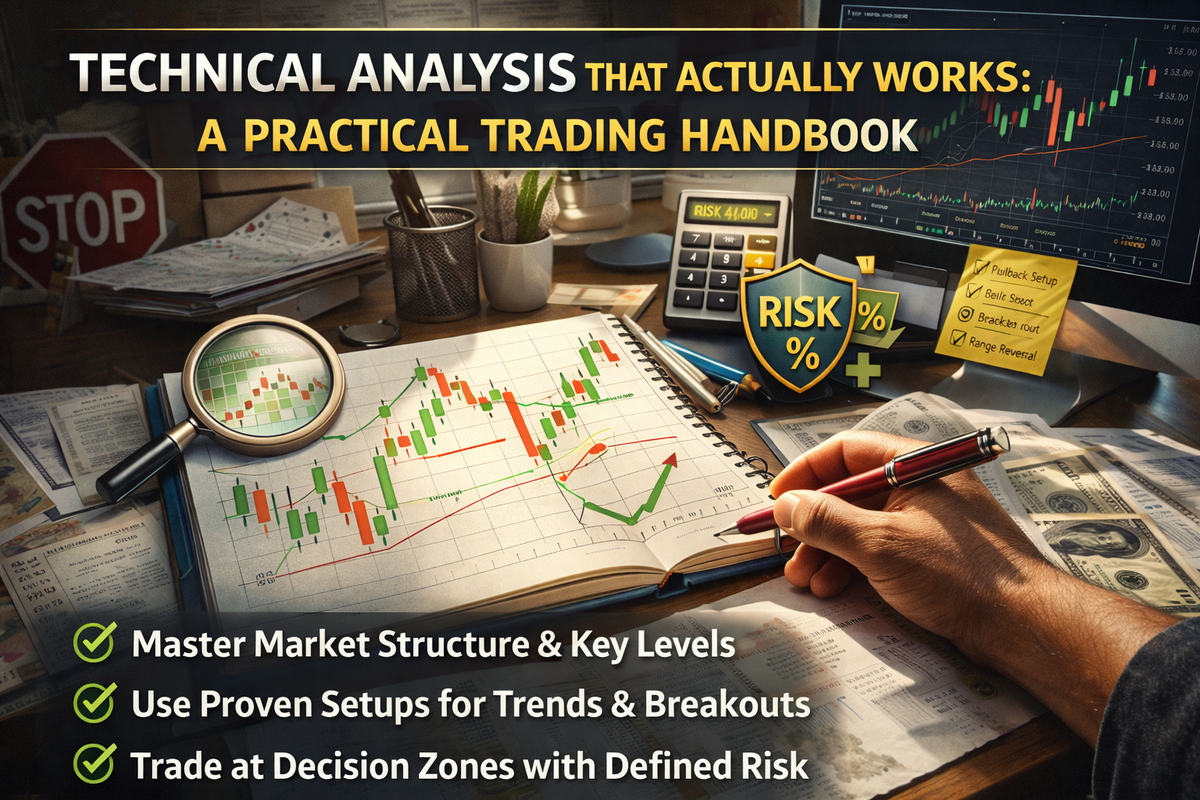
Technical Analysis That Actually Works: A Practical Trading Handbook
Introduction: Why Most Technical Analysis Fails
Technical analysis fails for most traders for one simple reason: they treat it like fortune-telling. They draw a few lines, add a few indicators, and expect certainty. Real technical analysis is not prediction. It is a structured way to identify where decisions matter, define risk, and execute with discipline.
When technical analysis works, it works because it aligns with how markets actually behave:
Price moves in waves. Liquidity clusters around obvious levels. Trends expand, then consolidate. Breakouts either get accepted or rejected. Participants respond to key zones, not random indicator signals.
This handbook is designed to remove the noise and give you a practical framework you can use across forex, gold (XAU/USD), indices, and most liquid markets.
What Technical Analysis Is Really For
Technical analysis has three jobs, and if it does not accomplish all three, it is not useful:
1) Identify context: Are we trending, ranging, or transitioning?
2) Identify decision zones: Where is price likely to react?
3) Define risk and execution: Where is invalidation, and how do we enter with rules?
If your charting does not improve decision quality and risk clarity, it is decoration.
The Core Principle: Market Structure Comes First
Everything in technical analysis becomes simpler when you start with market structure.
Market structure is the sequence of swing highs and swing lows:
Uptrend: higher highs and higher lows
Downtrend: lower highs and lower lows
Range: repeated highs and lows with no progression
Transition: structure shifting from trend to range or vice versa
Most “indicator confusion” disappears when you correctly label structure.
How to read structure like a professional
Pick one higher timeframe that matches your style:
Swing traders: daily and H4
Day traders: H1 and H4
Scalpers: M15 and H1 (with H4 context)
Then mark only the obvious swing points. Do not over-mark.
A serious rule: if you have to debate whether a swing high is real, it is not relevant.
Support and Resistance That Works: Zones, Not Lines
Support and resistance is not a single price. It is an area where orders tend to cluster. That is why zones outperform thin lines.
Strong zones often come from:
Prior swing highs and lows
Weekly and daily highs/lows
Breakout levels that later become retest zones
Consolidation boundaries
Round-number regions when aligned with structure
A clean method:
Find where price strongly rejected or strongly accepted. Mark the zone that contains the key wicks and bodies. Keep zones wide enough to reflect volatility, but not so wide that they are meaningless.
Supply and Demand: Useful When You Treat It Correctly
Supply and demand zones can be effective, but only when grounded in structure.
A practical definition:
Demand zone: area where buyers previously caused a strong rally and price later returns
Supply zone: area where sellers previously caused a strong drop and price later returns
The mistake retail traders make is marking every candle cluster as a zone. Serious traders mark the zones that produced displacement and structure shifts.
A simple filter:
If the move away from the zone did not break a meaningful swing level, the zone is weaker.
Trend Analysis That Works: Direction Plus Timing
Trends are where traders make most of their money because trends create follow-through.
To trade trends properly, you need two components:
Direction: higher timeframe structure confirms trend
Timing: lower timeframe gives a pullback or breakout trigger
A professional trend approach is not buying every green candle. It is buying pullbacks into support within an uptrend, or selling rallies into resistance within a downtrend.
The pullback rule that improves entries
In an uptrend, wait for price to pull back into a prior support zone or key level, then wait for confirmation that buyers defended it. In a downtrend, wait for price to rally into a supply zone, then wait for sellers to defend.
This is a structural approach, not a pattern-chasing approach.
Range Analysis: The Market’s Most Common State
Markets spend a lot of time ranging. Range trading is profitable when done correctly and disastrous when done casually.
A range has three key areas:
Upper boundary: where price repeatedly rejects
Lower boundary: where price repeatedly holds
Midpoint: magnet zone where price often returns
Professional range rules:
Trade near the edges, not the middle.
Use tight, invalidation-based stops beyond the boundary with a volatility buffer.
Take profits at the midpoint or opposite edge unless there is evidence of a breakout.
If you keep taking trades in the middle of a range, you are paying spread and slippage for randomness.
Breakouts That Actually Work: Acceptance Over Excitement
Most breakout traders lose money because they chase the first candle. Professional breakout trading focuses on one concept: acceptance.
A breakout is not “price touched above a level.” A breakout is “price moved above the level and the market accepted higher prices.”
A practical acceptance checklist:
Price closes beyond the level with meaningful body size.
Retest holds the level as support or resistance.
Subsequent price action shows continuation rather than immediate reversal.
This is why breakout plus retest is a high-quality pattern across markets.
The Three Setups That Cover Most Markets
A serious trader does not need 20 patterns. You need a small playbook you execute repeatedly.
Setup 1: Trend pullback continuation
Trend on higher timeframe, pullback to a zone, confirmation entry, stop beyond pullback low/high.
Setup 2: Breakout and retest
Compression or range boundary breaks, retest holds, entry on confirmation, stop beyond retest.
Setup 3: Range reversal at extremes
Market is ranging, entry at edge after rejection, target midpoint then opposite edge, stop beyond boundary.
These three setups handle trend, expansion, and range conditions. Master these before you add anything else.
Candlestick Patterns: Use Them as Confirmation, Not as a Strategy
Candlesticks can be useful, but only in context.
A bullish engulfing candle in the middle of nowhere is meaningless. A bullish engulfing candle at a demand zone in an uptrend can be useful as an execution trigger.
Same for pin bars and rejection wicks. They matter when they appear at decision zones.
The rule: candlesticks confirm location and intent. They do not replace structure.
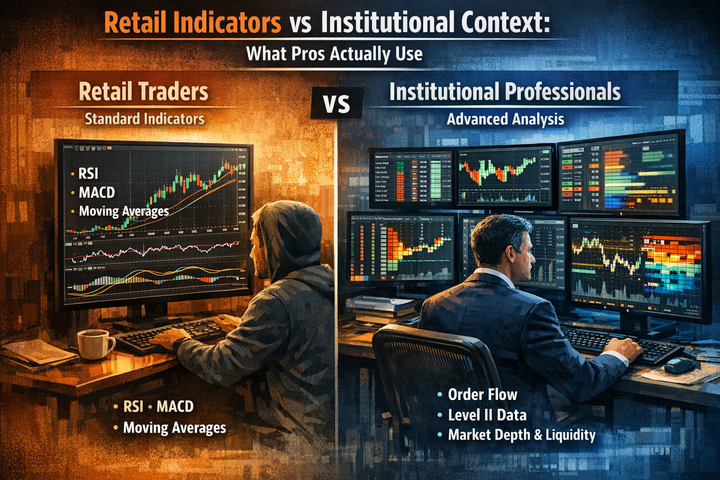
Indicators: When They Help and When They Hurt
Indicators are not evil. They are tools. The problem is when traders use them as decision makers instead of decision helpers.
Indicators can help with:
Trend filtering: moving averages, not as signals but as regime guides
Volatility awareness: ATR for realistic stops and targets
Momentum context: RSI as a condition tool, not as a buy/sell button
Indicators hurt when:
You stack too many and create conflicting signals.
You trade crossovers without context.
You ignore price structure because the indicator “says so.”
A professional indicator rule:
If you remove the indicator and your analysis collapses, your analysis was not technical analysis. It was indicator dependency.
Multi-Timeframe Analysis: The Cleanest Way to Avoid Bad Trades
Multi-timeframe analysis is not complicated. It is alignment.
Higher timeframe tells you where you are. Lower timeframe tells you when to act.
A simple workflow:
Weekly or daily: major zones and dominant structure
H4 or H1: current regime and active levels
M15 or M5: entry triggers and execution
This prevents common retail errors like taking a bullish signal on M5 directly into daily resistance.
Execution Rules: Where Most Traders Lose Their Edge
Even a great technical setup becomes unprofitable with bad execution.
Professional execution is defined by:
Invalidation first: know where the idea is wrong
Size from risk: position size derived from stop distance
Predefined target: based on structure, not emotion
No stop widening: you can tighten stops, not widen them
R-based tracking: measure results in R, not money
If you want technical analysis that actually works, you must combine chart logic with risk logic.
A Practical Example: How a Professional Builds a Trade
Imagine a clean uptrend on H4. Price pulls back into a prior breakout zone that previously acted as resistance and now may act as support. On M15 you see a rejection wick and a break above a minor structure level.
The professional plan is simple:
Entry occurs only after confirmation that support held.
Stop is placed below the pullback low and below the zone.
Position size is calculated so the loss is fixed if the stop hits.
Target is set at the prior swing high, with a potential extension to the next zone.
Management rules are predefined, not improvised.
This is technical analysis in practice: context, location, trigger, invalidation, risk, execution.
The Technical Analysis Checklist You Should Use Daily
Before you trade, answer these questions:
What is the higher timeframe structure: trend, range, or transition?
Where are the key zones: weekly and daily levels, major swing points?
Is price at a decision zone or in the middle of noise?
What is my setup: pullback, breakout retest, or range reversal?
What is my entry trigger and invalidation?
Does volatility allow a realistic stop and target?
What is my position size based on fixed risk?
What is the next level that price is likely to react to?
If you cannot answer these, you are not trading a plan.
Common Technical Analysis Mistakes That Destroy Consistency
Drawing too many levels until anything can be justified
Trading patterns without context or structure
Placing stops at obvious levels with no buffer
Using tight stops on volatile instruments like gold
Chasing breakouts without acceptance proof
Trading against the higher timeframe at major zones
Relying on indicators to make decisions for you
If you correct these, most traders see immediate improvement.
Frequently Asked Questions
Is technical analysis enough to trade profitably?
It can be, but profitability depends on execution and risk management. Technical analysis identifies opportunity. Risk management determines whether that opportunity becomes consistent results.
What is the best timeframe for technical analysis?
The best timeframe is the one that matches your style. Higher timeframes generally produce cleaner signals. Lower timeframes require more precision and discipline. Serious traders use multi-timeframe alignment rather than a single timeframe.
Are support and resistance still relevant?
Yes, especially in liquid markets. The key is to treat them as zones, align them with structure, and avoid over-marking.
Do indicators work?
Indicators can help with trend and volatility context, but they rarely work as standalone buy or sell signals. Price structure and execution rules matter more.
Conclusion: The No-Fluff Technical Analysis Standard
Technical analysis works when it becomes a disciplined framework, not a guessing game.
If you want a practical standard you can apply immediately:
Start with market structure.
Mark zones, not lines.
Trade at decision points, not in the middle.
Use a small playbook of repeatable setups.
Use candlesticks as confirmation, not as a strategy.
Use indicators only as context tools.
Define invalidation before entry and size from risk.
Track results in R and refine with evidence.


Comments ()