Investing Explained Simply: What It Is, Why It Matters, and How to Start (Without Feeling Overwhelmed)
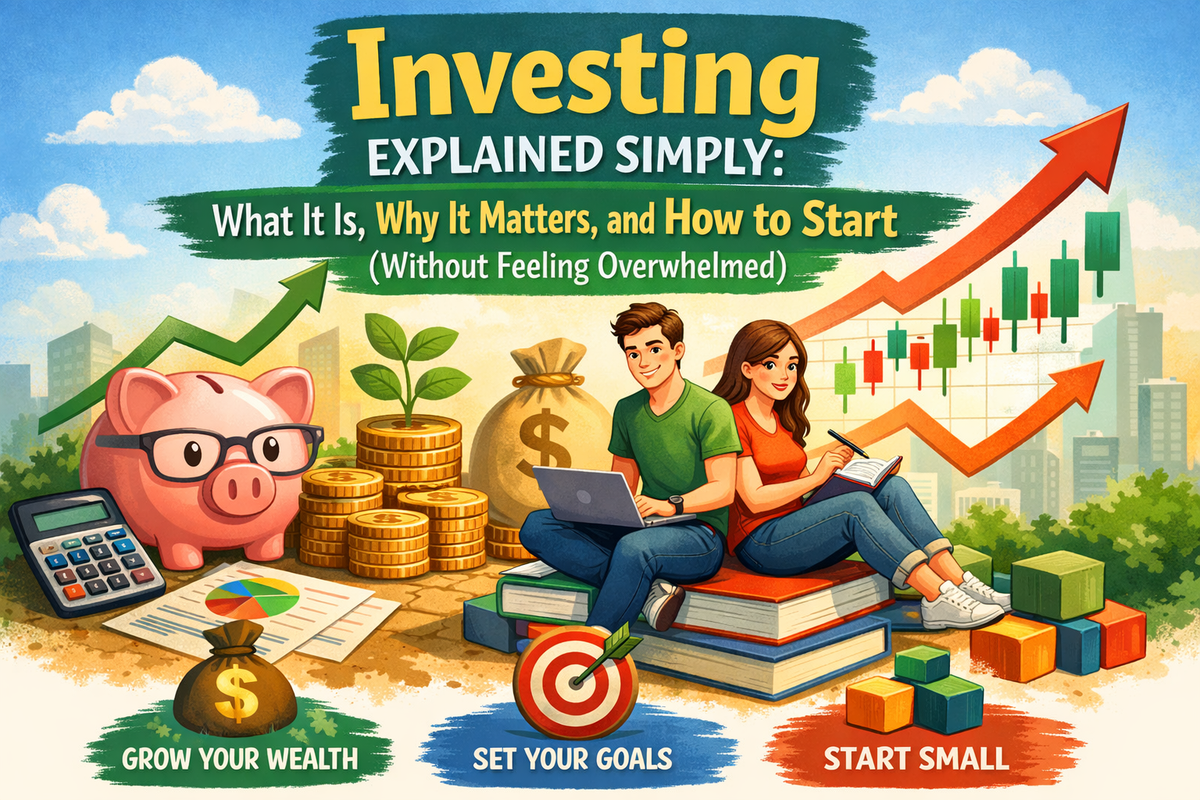
Most people think investing is something you do when you’re already wealthy, already confident, or already “good with money.” That’s the biggest misunderstanding of all.
Investing is not a luxury. For most people, it is the method that turns regular income into long-term security. It’s how you stop relying only on your next payslip and start building an asset base that can support your future goals: buying a home, raising a family, changing careers, funding education, retiring comfortably, or simply sleeping better because you have options.
This article explains investing in plain language. No hype. No complicated math. Just the core idea, why it matters, and a simple framework you can use to get started.
1) What is investing (in simple terms)?
Investing means putting money into assets that can grow in value or produce income over time.
You invest with the expectation that, over the long run, your money will become more money.
That’s it.
An asset is something that has value and can potentially increase in value or generate cash flow. Common examples include:
- Stocks (shares): You own a small piece of a company.
- Bonds: You lend money to a government or company; they pay you interest.
- Funds (index funds / ETFs): A basket of many stocks or bonds in one purchase.
- Property: Real estate that can rise in value and/or generate rental income.
- Cash savings: Low risk, but usually low growth.
Investing is different from saving. Saving is about protection and access. Investing is about growth and long-term value.
A simple way to remember it:
- Savings are for near-term needs and emergencies.
- Investments are for long-term goals and wealth building.
2) Why investing matters more than ever
If you do nothing with your money—if it just sits—time doesn’t stand still. Prices change. Costs rise. Life happens.
Here are the big reasons investing is important.
A) Investing helps you keep up with inflation
Inflation is the quiet force that makes £100 today buy less than £100 in the future. Even if inflation feels small in a single year, over time it adds up.
If your money sits in a place that earns little or nothing, your purchasing power falls. You may have the same number of pounds, but those pounds buy less.
Investing is one of the few realistic ways ordinary people can try to outpace inflation over long periods.
B) Investing lets compounding do the heavy lifting
Compounding is what happens when your money earns returns, and then those returns start earning returns too.
Think of it like a snowball rolling downhill. At the top, it looks small. But it builds, and then it builds faster.
The key point: compounding rewards time more than it rewards brilliance. Starting earlier often matters more than picking the “perfect” investment.
C) Investing turns income into assets (and assets create freedom)
If all you ever do is earn and spend, your financial life resets each month. Income arrives, bills leave, repeat.
Investing changes that loop. You start building assets that can support you later.
That support could look like:
- dividend income (some companies and funds pay you cash)
- interest income (bonds and savings)
- asset growth (your investments rise in value)
- flexibility (you can take a risk on a new career or business)
Freedom is not only about being rich. It’s often about having time, choices, and reduced stress.
D) Investing helps you reach big goals faster
Some goals are too large to reach just by saving a little each month in cash.
Examples:
- retirement funding
- buying property
- children’s future costs
- building a “buffer” that covers 6–12 months of expenses
Investing is not a guarantee of success, but it is a tool that can make big goals more realistic.
3) The real purpose of investing: closing the “gap”
Most people underestimate a simple reality:
Your future needs are usually bigger than your future savings if your savings do not grow.
This is the “gap.” It’s the distance between:
- what you’ll likely need in the future, and
- what you can realistically set aside from income alone.
Investing is how many people close that gap.
It’s not about beating the market every week. It’s about building a plan that works over years and decades.
4) Risk is not the enemy—confusion is
When people avoid investing, they often say “it’s too risky.” Sometimes they mean genuine risk. More often, they mean they don’t fully understand what they’re doing.
Let’s simplify risk:
- Short-term risk: Prices can drop this month or this year.
- Long-term risk: Not reaching your goals because your money didn’t grow enough.
Avoiding investing can reduce short-term ups and downs, but it can increase the long-term risk of falling behind.
A more useful approach is to manage risk rather than avoid it.
How?
- invest for the right time horizon (long-term money stays invested)
- diversify (don’t put everything in one place)
- keep costs low (fees matter)
- stay consistent (avoid emotional decisions)
5) The building blocks: how investing actually works
You don’t need to become a finance expert. But you do need a few basics.
A) Return
A return is what you gain (or lose) from an investment.
Returns can come from:
- growth: the asset’s price rises
- income: dividends (stocks) or interest (bonds)
B) Time horizon
Your time horizon is when you need the money.
- Short term (0–3 years): usually better suited to cash/savings because markets can be volatile.
- Medium term (3–10 years): can invest, but with more caution and balance.
- Long term (10+ years): historically, this is where investing has had the best chance to work.
A common mistake is investing money you might need soon. That creates stress and forces you to sell at bad times.
C) Volatility
Volatility is just the price moving up and down. It’s normal.
The goal is not “no volatility.” The goal is a plan you can stick to when volatility happens.
D) Diversification
Diversification means spreading your money across many investments so one problem doesn’t wreck your whole plan.
A single company can fail. A broad market fund spreads risk across many companies.
This is why many beginners start with index funds or ETFs that hold hundreds or thousands of stocks.
6) The simplest investing approach for most beginners
If you want a simple, practical starting point, here is a widely used idea:
Build a diversified, low-cost portfolio and invest consistently over time.
For many people, that can be as basic as:
- a broad stock market index fund/ETF (for growth)
- plus a bond fund/ETF (to reduce volatility), depending on age and risk tolerance
This is not a recommendation for your personal situation—just a common framework.
Why it’s popular:
- it’s simple
- it’s diversified
- it’s low maintenance
- it avoids the stress of stock-picking
- it relies more on consistency than prediction
7) A simple example that shows why investing is powerful
Imagine two people:
Person A saves £200/month in cash.
Person B invests £200/month into a diversified portfolio.
Over one year, the difference might look small. But over 10–20 years, the investing path can pull ahead because of compounding.
The point isn’t the exact numbers (markets vary). The point is the mechanism:
- consistent contributions + time + reinvested growth = compounding
The earlier you start, the more time compounding has to work.
8) The “investing ladder”: the sensible order of operations
Investing works best when it’s built on a stable foundation. Here is a practical order many people follow.
Step 1: Cover the basics
- Know what you earn and what you spend.
- Reduce obvious money leaks.
- Create a simple budget you can live with.
Step 2: Build an emergency fund
Before investing heavily, many people aim for 3–6 months of essential expenses in cash savings (more if income is unstable).
This reduces the chance you’ll be forced to sell investments when life happens.
Step 3: Pay down toxic debt
Some debt has very high interest (credit cards, payday loans). That’s a guaranteed “negative return.”
Paying that down is often the best financial move before investing aggressively.
Step 4: Start investing consistently
Then you invest regularly, not perfectly.
Perfection is not required. Consistency is.
9) The most common investing mistakes (and how to avoid them)
Mistake 1: Trying to get rich quickly
If someone promises guaranteed high returns quickly, be cautious.
Real investing is usually boring. Boring is good.
Mistake 2: Investing without a plan
A plan answers:
- What is the money for?
- When do I need it?
- How much risk can I tolerate?
- What will I do when markets fall?
Without a plan, emotions take over.
Mistake 3: Checking your investments constantly
Daily checking creates anxiety and encourages impulsive decisions.
For long-term investing, you usually don’t need daily updates. You need a process.
Mistake 4: Panic selling during downturns
Market drops feel scary, but they are normal.
Many people lose money not because investing “doesn’t work,” but because they sell when prices are low and buy again after prices rise.
Mistake 5: Ignoring fees
Small fees can quietly reduce returns over many years.
It’s not exciting, but it matters.
Mistake 6: Chasing the “next big thing”
Trends come and go. A diversified portfolio can give you exposure to growth without betting everything on one story.
10) A beginner-friendly investing mindset
If you want investing to work for you long-term, focus on these principles:
- Think in years, not days.
- Control what you can control: contributions, diversification, costs, and behaviour.
- Expect downturns. They are not a sign you failed. They are part of the process.
- Keep it simple enough to stick with. A complex plan you abandon is worse than a simple plan you follow.
11) So what should you invest in?
This question is where people often want a fast answer. But a good answer depends on you:
- your timeline
- your income stability
- your existing savings
- your goals
- your comfort with ups and downs
That said, many beginners start by learning the “big categories”:
- Equities (stocks): higher potential growth, more volatility
- Bonds: lower volatility, often lower long-term returns, can stabilise a portfolio
- Cash: stable, accessible, but may lag inflation over time
And then they use funds/ETFs as an easy way to diversify.
If you want investing to be simple, aim for broad diversification and low costs, rather than chasing “the best stock.”
12) How much should you invest?
A simple approach many people use:
- Start with an amount you can invest consistently without stress.
- Increase it slowly as your confidence and income grow.
Even a small amount matters because it builds the habit. Habits are what create results over time.
If you can automate monthly investing, it becomes a system instead of a willpower battle.
13) Investing is also psychological (and that’s normal)
One of the most overlooked facts about investing is that the hardest part is not the math.
It’s the mind.
You will face moments when:
- markets drop and headlines look scary
- everyone seems to be making money in something you don’t own
- your patience is tested
This is why simple plans often outperform complicated ones in real life. Simplicity lowers the chance of emotional mistakes.
A calm investor with a basic strategy can do very well over time.
14) Why investing is important even if you don’t earn a lot
People sometimes say, “I don’t earn enough to invest.” If that’s your situation, it’s understandable—costs are real.
But investing is not only for high incomes. It’s also for:
- building a habit
- learning the process
- making your future self’s life easier
Starting small can still be meaningful. What matters is that you start intentionally, within your limits, without putting your present stability at risk.
15) A simple “one-page” summary you can remember
If you remember nothing else, remember this:
- Investing means putting money into assets that can grow or pay you over time.
- It matters because inflation erodes cash, and compounding rewards time.
- The goal is not quick wins. The goal is long-term progress.
- Most beginners do best with diversification, low fees, and consistency.
- The biggest risk is not market movement—it’s giving up the plan.
Final note (important)
This article is educational and general, not personal financial advice. If you want, tell me your country (UK or elsewhere), your time horizon (e.g., 5 years, 15 years), and your goal (retirement, house deposit, long-term wealth), and I can outline a simple beginner framework and terminology that fits your context—still in plain language.
Comments ()