How Institutional Traders Think: Proof, Process, and Positioning
Introduction: Why “Institutional Thinking” Matters for Serious Traders
Most retail traders try to predict price. Institutions try to manage probability. That difference changes everything. Institutional trading is not magic, secret indicators, or mythical “smart money” narratives. It is a professional method for decision-making under uncertainty, built on evidence, repeatability, and risk control.
When traders say “institutions move the market,” what they really mean is that large participants influence price because they deploy size, manage portfolios, and respond to macro incentives. But the more important takeaway for you is this: you do not need institutional capital to adopt institutional thinking. You need institutional discipline.
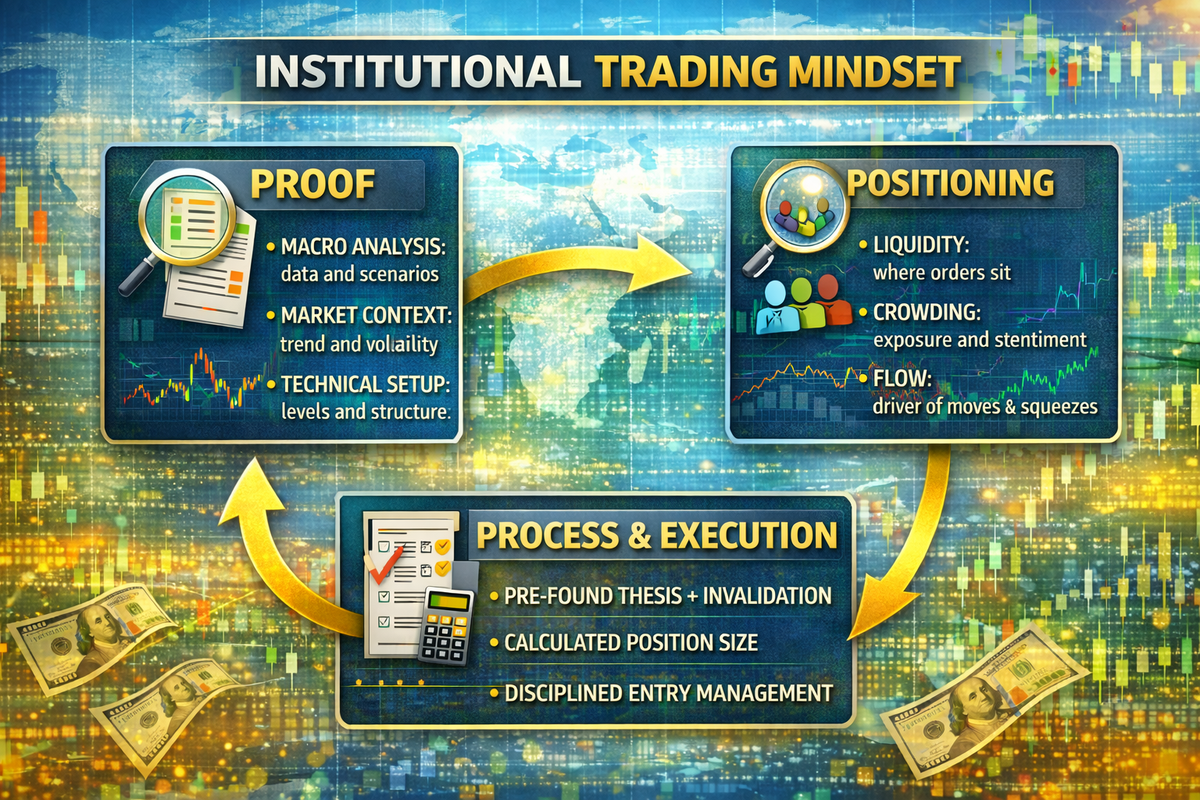
This article breaks down how institutions approach markets through three pillars:
Proof: decisions anchored in evidence, not opinions
Process: repeatable routines that remove emotion
Positioning: understanding where risk sits and how flows can drive price
When you combine these pillars, you stop trading like a gambler and start operating like a risk manager.
What Institutions Are Actually Trying to Achieve
A retail trader often asks, “Will price go up or down?” An institutional trader asks a different question: “How do we express a view with controlled downside and acceptable payoff, within portfolio constraints?”
Institutions typically aim for:
Risk-adjusted returns, not maximum returns
Consistency across cycles, not a single lucky year
Capital preservation under stress
Controlled exposure across assets, currencies, and themes
Robust decision-making with imperfect information
They do not need to be right all the time. They need to avoid being wrong in a catastrophic way.
How Institutional Traders Define Proof
Institutional “proof” is not certainty. It is justification. It is the ability to explain, in a structured way, why a trade exists and what evidence supports it.
Institutional proof often includes three layers:
Macro evidence: rates, inflation, growth, central bank direction, fiscal risk
Market evidence: trend, volatility regime, correlation shifts, liquidity conditions
Technical evidence: levels, structure, acceptance/rejection, timing
The key is that institutions use technicals as a way to execute and manage, not as a substitute for logic.
Proof is probability, not prediction
Institutions rarely say, “This will happen.” They say, “If this happens, we will do that.” They build a conditional plan. They treat analysis as a decision tree.
A retail trader often commits emotionally to a single narrative. Institutional traders plan for two or three possible outcomes and adjust exposure accordingly.
The Institutional Decision Tree: Scenario Thinking
Scenario thinking is a foundation of professional trading. Instead of needing certainty, institutions create “if-then” plans.
Example of institutional-style framing in FX:
If inflation remains sticky and the central bank signals higher-for-longer, yields may rise and the currency may strengthen. If growth cracks and the market prices cuts, yields may fall and the currency may weaken. The trade is not the forecast. The trade is the exposure you take based on which scenario becomes more likely.
Your job as a serious trader is to stop treating the market like a quiz with one correct answer. Treat it like a probability engine.
The Role of Process: Why Institutions Win the Long Game
Institutional traders do not rely on motivation. They rely on systems. A process creates discipline even when your emotions fail.
A typical institutional process includes:
A fixed research routine
A playbook of approved trade types
A risk framework with hard limits
Execution protocols and order discipline
Ongoing measurement and review
Retail traders often trade when they feel like it. Institutions trade within mandates and constraints. That is not restrictive. That is what produces consistency.
The Institutional Research Routine (Simplified for Serious Traders)
You do not need a team to run a professional routine. You need structure.
A practical institutional-style routine for forex and gold can look like this:
Daily you check the macro calendar and identify high-impact risk events. You update key levels and understand where liquidity likely sits. You define your regime: trend, range, or transition. You create scenario A and scenario B. You predefine invalidation and risk. Then you execute only if your playbook setup appears.
Weekly you update your macro narrative and map the largest timeframes. You evaluate whether the regime changed. You review your trades in R multiples, not money. You measure errors. You refine rules only when data supports change.
This routine is not about doing more work. It is about doing the right work at the right cadence.
The Institutional Playbook: Fewer Trades, Higher Quality
Institutions do not “take every signal.” They trade a limited set of repeatable expressions.
In the professional world, a playbook is a list of trade types that are permitted, defined, and understood. For serious traders, your playbook should be small and clear.
Examples of institutional-style expressions:
Trend expression: align with a higher timeframe trend and use pullbacks for entries
Relative value: trade one asset versus another based on macro divergence
Event risk expression: structure exposure around catalysts with defined risk
Mean reversion: fade extremes when volatility and positioning suggest exhaustion
The point is not the strategy label. The point is that each play has entry rules, invalidation rules, and sizing rules.
Risk Is the Core of Institutional Thinking
Institutions are not rewarded for being right. They are rewarded for managing risk.
Institutional risk discipline typically includes:
Risk per position and risk per theme
Maximum drawdown thresholds
Portfolio exposure limits
Correlation and concentration controls
Liquidity constraints and sizing based on market depth
Retail traders often size based on confidence. Institutions size based on risk budgets.
Risk budget thinking
A simple way to adopt this mindset is to treat your account as a portfolio with a risk budget.
For example:
You might allocate 1R total risk per day, 5R per week, and 10R per month. You might limit open risk to 2R at any time. You might limit total USD exposure across positions to avoid stacking the same bet.
This prevents the common retail problem of taking three correlated trades that are effectively one oversized position.
Positioning: What It Means and Why It Matters
Positioning is where risk sits across the market. It includes how leveraged players, asset managers, and hedgers are positioned, and how crowded a trade might be.
You do not need perfect positioning data to benefit from positioning awareness. You need to understand the principle:
When positioning is crowded, price can move violently when the crowd is forced to exit.
Crowded positioning often leads to:
Sharp squeezes against the consensus
Breakout failures when everyone is already in
Explosive continuation when forced exits begin
Volatility spikes around catalysts
This is why institutions respect catalysts. News does not “move markets” because of the headline alone. It moves markets because it forces positioning to reprice.
Liquidity: The Institutional Lens Retail Traders Miss
Institutions think in terms of liquidity. Liquidity is the ability to transact size without moving price too much. Price often moves toward liquidity because liquidity is where large orders can be absorbed.
In practical chart terms, liquidity often sits around:
Prior highs and lows
Round numbers and obvious levels
Consolidation boundaries
Large clusters of stop orders
This does not mean “stop hunts” are a conspiracy. It means markets seek areas where there are enough orders to facilitate large transactions. When price reaches those zones, you can see either continuation (if there is acceptance) or reversal (if liquidity is used to fill and fade).
For a serious trader, the practical takeaway is simple:
Do not place stops exactly on obvious levels. Use structure plus buffer. Do not chase moves into obvious liquidity zones without a plan for acceptance or rejection.
Institutional Execution: How They Enter Without Emotion
Institutions separate analysis from execution. They do not improvise entries because price is moving fast.
Execution is typically guided by:
Predefined triggers
Order types suited to the plan
Liquidity and timing considerations
Risk checks before placing the order
In retail terms, you should adopt:
A pre-trade checklist, a specific entry trigger, and a rule that you do not enter without invalidation.
Order types used with intent
Market orders are used when certainty of entry matters more than price precision. Limit orders are used when you have a defined zone and want better pricing, accepting that you may miss the trade. Stop orders are used to enter only if momentum confirms.
Institutions choose order types strategically. Serious traders should do the same.
How Institutions Think About Stops and Invalidation
Institutional stops are typically based on invalidation, not emotion. If the thesis is wrong, they exit. They do not widen stops to “give it room” unless there is a legitimate thesis change and the risk budget supports it.
A serious retail rule that reflects institutional discipline is:
Your stop can be tightened, but it should never be widened.
Institutions also understand something retail traders often ignore: a stop is not only a loss control tool. It is a signal that the market’s information changed relative to your thesis.
Positioning Your Trade: Expression Matters More Than Direction
Institutions do not always take directional trades. They express views in a way that optimizes downside.
In a simplified retail context, you can still apply this principle by thinking about expression:
If you like a bullish idea but volatility is high, you may reduce size and widen stop. If you like a bearish idea but a major catalyst is imminent, you may wait for post-event confirmation. If correlation risk is high, you may choose one best expression instead of stacking multiple similar trades.
The question is not “bullish or bearish.” The question is “how do I express this view with controlled downside and acceptable payoff?”
The Institutional Timeframe Structure
Institutions typically anchor to higher timeframes because portfolio decisions are not made on M1 charts.
A practical approach for serious traders:
Use weekly and daily charts to define the macro structure and major zones. Use H4 and H1 to define the trading context and regime. Use M15 and M5 for entry timing only.
Lower timeframes provide execution precision. Higher timeframes provide signal quality.
The Institutional Review Loop: Why They Improve Faster
Institutions measure everything. They review performance systematically. They do not “feel” whether something works. They quantify it.
A serious review process includes:
Tracking outcomes in R multiples
Separating setup quality from execution quality
Measuring mistakes as a category, not as a mood
Identifying which setups and sessions produce the best expectancy
Removing low-quality trades and time windows
If you do not track mistakes, you repeat them. If you do not track expectancy, you optimize the wrong metric, usually win rate.
Institutional Mistakes Retail Traders Can Avoid
Retail traders often lose money because they make the same structural errors repeatedly.
Common errors include:
Trading without a scenario plan and reacting emotionally to price movement
Taking trades with undefined invalidation
Using tight stops in volatile instruments and calling it risk management
Stacking correlated positions and accidentally taking oversized exposure
Moving stops wider and turning a controlled loss into a large loss
Overtrading low-quality conditions because they want action
Ignoring event risk and being surprised by volatility
Institutional thinking is essentially a list of habits that prevents these failures.
A Practical Institutional Framework You Can Use Today
You can adopt institutional thinking immediately by operating with these rules:
You must have a thesis and a catalyst or a structural reason for movement. You must have scenario A and scenario B. You must define invalidation before entry. You must calculate position size from risk and stop distance. You must cap open risk across all trades. You must avoid stacking correlated exposure. You must stop trading after reaching daily loss limits. You must review weekly in R multiples and update your playbook based on evidence.
This is the difference between trading as entertainment and trading as a business.
Frequently Asked Questions
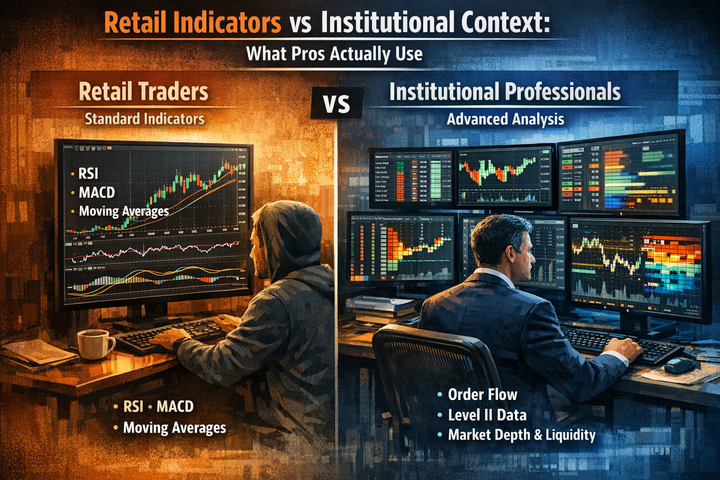
Do institutions use indicators?
Some do, but indicators are not the core of institutional decision-making. Institutions rely on macro context, risk budgets, positioning awareness, and structured execution. Indicators may be used as secondary tools, not as primary proof.
Do institutions “hunt stops”?
Markets tend to move toward liquidity, which often sits near obvious levels where stop orders cluster. This is not necessarily a conspiracy. It is a mechanical outcome of how orders and liquidity work. The practical solution is to place stops at invalidation with a buffer and avoid chasing moves into obvious liquidity zones.
Can retail traders really think like institutions?
Yes. You may not have the same data or capital, but you can adopt the same mindset: evidence-based decisions, repeatable process, and disciplined risk. That alone can dramatically improve results.
What is the most important institutional habit?
Separating analysis from execution and obeying risk budgets. Institutions survive because they do not allow one trade, one day, or one week to break the system.
Conclusion: Proof, Process, and Positioning Creates Professional Trading
Institutional traders succeed because they do not treat the market like a guessing game. They treat it like a risk-managed probability business.
If you want to trade like a professional, build your approach around:
Proof: decisions anchored in evidence and scenarios
Process: routines and playbooks that remove emotion
Positioning: awareness of liquidity, crowding, and flow-driven moves
When you apply these consistently, your trading becomes more stable, your drawdowns become smaller, and your performance becomes measurable.

Comments ()