Gold Breakouts vs Fakeouts: How to Filter Them
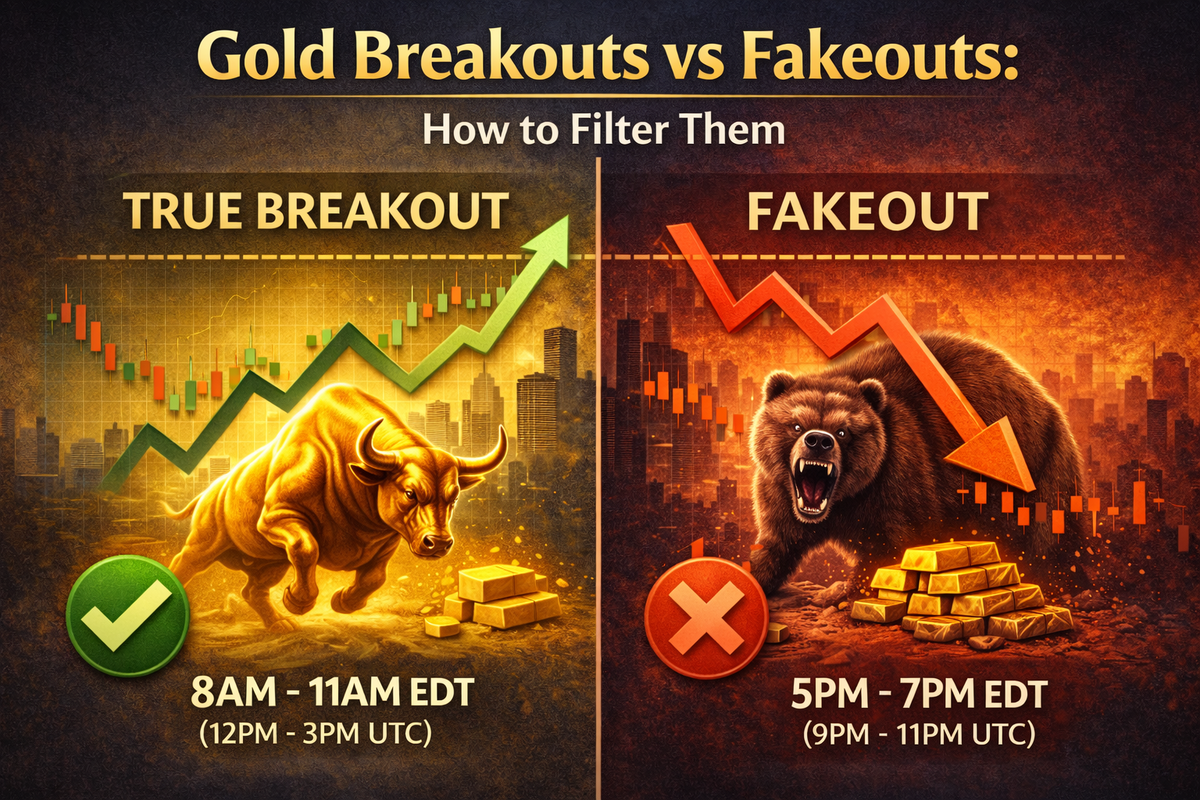
Gold trading presents unique opportunities and challenges for traders worldwide. One of the most critical skills any gold trader must master is the ability to distinguish between genuine breakouts and deceptive fakeouts. This comprehensive guide explores the technical methods, indicators, and strategies that enable traders to filter real market moves from false signals in the gold market.
Understanding Breakouts and Fakeouts in Gold Trading
A breakout occurs when gold prices decisively move beyond a clearly defined support or resistance level, signaling a potential shift in market direction. For instance, when gold surges above a major resistance level at $2,700 per ounce with strong momentum, it may indicate the beginning of a new uptrend.
Conversely, a fakeout (also called a false breakout) happens when gold prices briefly pierce a key technical level but quickly reverse direction, leaving traders trapped on the wrong side of the market. These false signals drain capital and erode trader confidence, making them one of the most costly scenarios in gold trading.
Why Fakeouts Occur in the Gold Market
Understanding the mechanics behind fakeouts helps traders anticipate and avoid them. Several factors contribute to false breakouts in gold:
Market Manipulation and Liquidity Hunting
Institutional traders and market makers often engineer fakeouts to trigger stop-loss orders clustered around key technical levels. This practice, known as "stop hunting," creates temporary price spikes that reverse once retail traders are shaken out of their positions. The gold market, despite its size, remains susceptible to these tactics, particularly during low-liquidity periods.
Low-Liquidity Time Windows
Fakeouts frequently cluster around specific trading sessions when market participation is thin. For gold traders, this often occurs during the transition between the New York and Tokyo sessions, or during pre-market hours when fewer participants are active. During these windows, smaller orders can push prices through technical levels without sufficient buying or selling conviction to sustain the move.
Absence of Fundamental Catalysts
Breakouts that occur without accompanying fundamental news or economic data often lack the conviction necessary for sustained directional movement. When gold breaks a major level without a clear catalyst—such as Federal Reserve announcements, inflation data, or geopolitical events—the probability of reversal increases substantially.
Volume: The Ultimate Breakout Verification Tool
Volume analysis stands as the single most reliable indicator for distinguishing genuine breakouts from fakeouts in gold trading.
High Volume Confirms Conviction
When gold breaks above resistance at $2,700 accompanied by unusually high trading volume, it signals broad market participation and genuine conviction. High volume indicates that numerous market participants agree with the directional move, providing the fuel necessary for sustained price action beyond the broken level.
Low Volume Signals Danger
A breakout occurring on low or declining volume represents a major red flag. If gold pushes through a significant resistance level but volume remains muted, the move lacks institutional support and is likely to reverse. This scenario often represents a trap set for retail traders who enter positions based solely on price action without confirming volume participation.
Practical Volume Analysis Example
Consider gold trading at $2,680 approaching a resistance level at $2,700. A genuine breakout would show:
- Volume increasing as price approaches $2,700
- A surge in volume as price breaks through $2,700
- Sustained elevated volume as price continues higher
- Strong closing price well above $2,700
A fakeout scenario would display:
- Declining volume as price approaches $2,700
- Minimal volume increase during the breakout
- Immediate volume spike on the reversal
- Closing price back below $2,700
On-Balance Volume: The Fakeout Detection Indicator
The On-Balance Volume (OBV) indicator provides a powerful technical tool for confirming breakout validity and identifying fakeouts before they trap traders.
How OBV Works in Gold Trading
OBV accumulates volume on up days and subtracts volume on down days, creating a cumulative line that reveals the underlying buying and selling pressure. This indicator helps traders see beyond price action to understand whether institutional money flows support a breakout.
Valid Bullish Breakout Confirmation
When gold breaks above a resistance level, check the OBV indicator. If OBV simultaneously makes a new higher high, it confirms that the breakout occurred with increased buying activity. This alignment between price and volume validates the strength of the upward movement and increases the probability of continuation.
For example, if gold breaks resistance at $2,750 and OBV reaches a new peak above its previous high, traders can have greater confidence that the breakout represents genuine buying pressure rather than a temporary spike.
Identifying Bearish Fakeouts
When gold appears to break support, OBV provides critical confirmation. A valid bearish breakout should show OBV forming a new lower low, indicating increased selling pressure. If price breaks support but OBV fails to confirm with a new low, the breakdown likely represents a fakeout that will reverse higher.
Momentum Indicators: The Hidden Confirmation Layer
Momentum oscillators reveal what happens beneath the surface of price action, providing essential confirmation that many traders overlook.
RSI (Relative Strength Index) Analysis
The RSI measures the speed and magnitude of price movements, offering insights into breakout sustainability. For genuine gold breakouts:
Strong Momentum Confirmation: When gold breaks resistance and RSI simultaneously moves above 60-70, it confirms strong upward momentum supporting the breakout.
Divergence Warning: If gold makes a new high above resistance but RSI forms a lower high, this bearish divergence signals weakening momentum and increases fakeout probability. This disconnect suggests that buyers are losing strength despite higher prices.
MACD (Moving Average Convergence Divergence)
MACD provides trend-following momentum by comparing two moving averages. Valid breakouts in gold typically show:
- MACD line crossing above the signal line during bullish breakouts
- Histogram bars expanding in the direction of the breakout
- Both MACD and price moving in alignment
Momentum Disagreement as a Warning
When momentum indicators flatten or diverge while gold prices attempt to break higher, buying pressure is diminishing. This scenario often precedes fakeouts and reversals. Traders should exercise extreme caution when price action and momentum indicators tell different stories.
Context and Price Structure: The Strategic Framework
Not all technical levels carry equal weight. Understanding market context dramatically improves breakout filtering accuracy.
Trend Alignment
Breakouts occurring in the direction of the prevailing trend demonstrate significantly higher success rates. If gold has been trending higher for weeks and breaks above resistance, that breakout aligns with the dominant market force. Conversely, counter-trend breakouts face stronger opposition and more frequently fail.
Significance of the Technical Level
Weekly or monthly support and resistance levels carry more weight than intraday or hourly levels. When gold breaks a resistance level that has held for months, particularly one visible on weekly charts, the breakout typically generates more follow-through than breaks of minor intraday levels.
For instance, a break above a multi-year high in gold prices commands far more market attention and follow-through than a break above yesterday's high.
Retest Behavior and Structural Confirmation
Genuine breakouts often demonstrate specific structural patterns:
The Retest Pattern: After breaking resistance, gold frequently returns to test the broken level. If the old resistance now acts as support and price bounces higher, it confirms the breakout's validity. This "back-test" provides high-probability entry opportunities for traders who missed the initial move.
Failed Retest Warning: If price breaks resistance but immediately plunges back through the level on the retest, the breakout was false. This failure pattern often creates strong reversal momentum in the opposite direction.
Building Your Fakeout Detection System
Systematic approaches outperform discretionary trading when filtering breakouts. Here's a comprehensive detection framework for gold traders:
Pre-Breakout Analysis
Identify the Key Level: Mark previous swing highs and lows, major round numbers ($2,500, $2,600, etc.), and levels where price has repeatedly reversed. These represent the most significant technical zones.
Assess Current Market Conditions: Determine whether gold is trending, ranging, or consolidating. Breakouts from consolidation patterns typically offer better risk-reward than breakouts from choppy, directionless markets.
Check the Economic Calendar: Note upcoming Federal Reserve meetings, inflation reports, employment data, and geopolitical events. Breakouts occurring near major catalysts tend to sustain better than those in news vacuums.
During-Breakout Observation
Wait for the Close: Don't chase breakouts in real-time. Instead, wait for the candle to close beyond the level. An intrabar spike that reverses before the close often signals a fakeout.
Monitor Volume in Real-Time: Track whether volume expands or contracts as the breakout develops. Declining volume during a breakout attempt serves as an early warning.
Observe Lower Timeframes: Switch to a 15-minute or 5-minute chart to examine microstructure. Look for rejection wicks, engulfing patterns, or rapid reversals that might not be visible on higher timeframes.
Post-Breakout Confirmation
Require a Second Close: One of the most effective fakeout filters involves waiting for two successive closes beyond the broken level on rising volume. This confirmation significantly reduces false signal risk.
Check for Follow-Through: Genuine breakouts typically show immediate continuation. If gold breaks $2,700 but stalls between $2,705-$2,710 for hours, the breakout lacks conviction.
Validate with Multiple Indicators: Ensure that volume, momentum indicators, and price structure all align to support the breakout before committing capital.
Practical Trading Strategies to Avoid Fakeouts
Armed with detection tools, traders can implement specific strategies that minimize fakeout exposure while capturing genuine breakouts.
The Wait-and-Retest Strategy
Rather than entering on the initial breakout, this conservative approach waits for price to return and retest the broken level. Entry occurs only if the retest holds and price resumes in the breakout direction. While this strategy occasionally misses fast-moving breakouts, it dramatically reduces fakeout losses.
Example: Gold breaks above $2,650 resistance. Instead of buying immediately, wait for gold to pullback toward $2,650. If it bounces from that level (now support) with increasing volume, enter long positions targeting higher prices.
The Fade-the-Fakeout Strategy
Advanced traders can profit from fakeouts by trading against them. This contrarian approach requires strict discipline and tight risk management:
Setup Identification: Look for breakouts occurring on low volume, during illiquid hours, or without fundamental catalysts.
Entry Trigger: Enter counter to the breakout once price returns inside the broken level. For example, if gold fakes above $2,700 then drops back below, enter short positions.
Risk Management: Place stops just beyond the false breakout high to limit losses if the move proves genuine.
The Confirmation Entry Strategy
This balanced approach seeks to capture breakouts while filtering fakeouts through layered confirmation:
Step 1: Identify the breakout candidate as price approaches a key level.
Step 2: Wait for the initial break on strong volume.
Step 3: Check momentum indicators for confirmation (RSI rising, MACD crossing bullish).
Step 4: Enter on the first pullback within the new range, or after two closes beyond the level.
Step 5: Place stops below the most recent swing low (for bullish breakouts) to protect capital.
Time-Based Fakeout Patterns in Gold
Gold exhibits specific intraday patterns that influence breakout reliability.
Session-Specific Considerations
Asian Session: Gold breakouts during Tokyo hours often lack follow-through due to lower Western participation. Exercise extra caution with breakouts occurring between 7 PM and 2 AM EST.
London Session: The opening of London markets (3 AM EST) brings significant liquidity to gold. Breakouts during this session demonstrate better sustainability.
New York Session: Maximum liquidity occurs when both London and New York overlap (8 AM to 12 PM EST). Breakouts during this window carry higher conviction.
After-Hours Moves: Breakouts occurring after the New York close frequently reverse when major markets reopen.
Risk Management for Breakout Trading
Even with sophisticated filtering, some fakeouts will inevitably occur. Proper risk management protects capital during these inevitable mistakes.
Position Sizing
Never risk more than 1-2% of trading capital on a single breakout trade. This conservative approach ensures that a series of fakeouts won't significantly damage your account.
Stop-Loss Placement
For bullish breakouts, place stops below the most recent swing low or just beneath the broken resistance level. For bearish breakouts, place stops above the most recent swing high. This placement provides room for normal volatility while limiting catastrophic losses.
Profit Targets
Measure the height of the consolidation pattern preceding the breakout and project that distance from the breakout point to establish initial targets. For example, if gold consolidates in a $50 range before breaking higher, target at least $50 of upside movement.
Conclusion
Distinguishing genuine breakouts from fakeouts in gold trading requires a systematic approach combining volume analysis, momentum indicators, structural context, and disciplined risk management. The On-Balance Volume indicator provides exceptional fakeout detection capabilities, while RSI and MACD offer crucial momentum confirmation. Understanding that fakeouts cluster around low-liquidity periods and often lack fundamental catalysts helps traders avoid the most obvious traps.
Successful gold traders don't chase every breakout. Instead, they patiently wait for multiple confirmations, verify volume participation, and ensure alignment between price action and underlying market structure. By implementing the detection frameworks and trading strategies outlined in this guide, traders can dramatically improve their breakout trading results while minimizing costly fakeout losses.
The key to long-term success lies not in predicting every market move perfectly, but in developing a repeatable process that consistently filters high-probability opportunities from low-probability traps. Master these techniques through practice, maintain disciplined risk management, and remember that protecting capital during uncertain setups is just as important as capturing profits during clear opportunities.


Comments ()