Fundamental Analysis for FX: Rates, Inflation, Jobs Data, and Why It Moves Markets
Introduction: Why Fundamentals Matter More Than Most Traders Admit
Many traders treat fundamentals as “news noise” and focus only on charts. That works sometimes, until it doesn’t. Forex is a macro-driven market. Currencies are not stocks. They are relative prices reflecting different growth paths, inflation paths, and interest rate expectations across countries.
A chart can show you where price is. Fundamentals explain why price is moving and why it may continue or reverse. The serious approach is not choosing one or the other. It is using fundamentals to define context and using technicals to time execution and manage risk.
This handbook gives you a practical framework for understanding rates, inflation, jobs data, and how those drivers interact with central banks and market expectations to move FX pairs.
The Core Concept: Forex Moves on Expectations, Not Headlines
The biggest mistake beginners make is assuming price reacts to data itself. In reality, FX reacts to the difference between:
What the market expected versus what actually happened
That difference is called the surprise. And the surprise matters only because it changes the market’s view of future policy.
A report can be “good” and still push a currency down if it was already priced in. A report can be “bad” and push a currency up if it reduces the chance of aggressive rate hikes, improving financial conditions. The market is forward-looking.
A simple mental model:
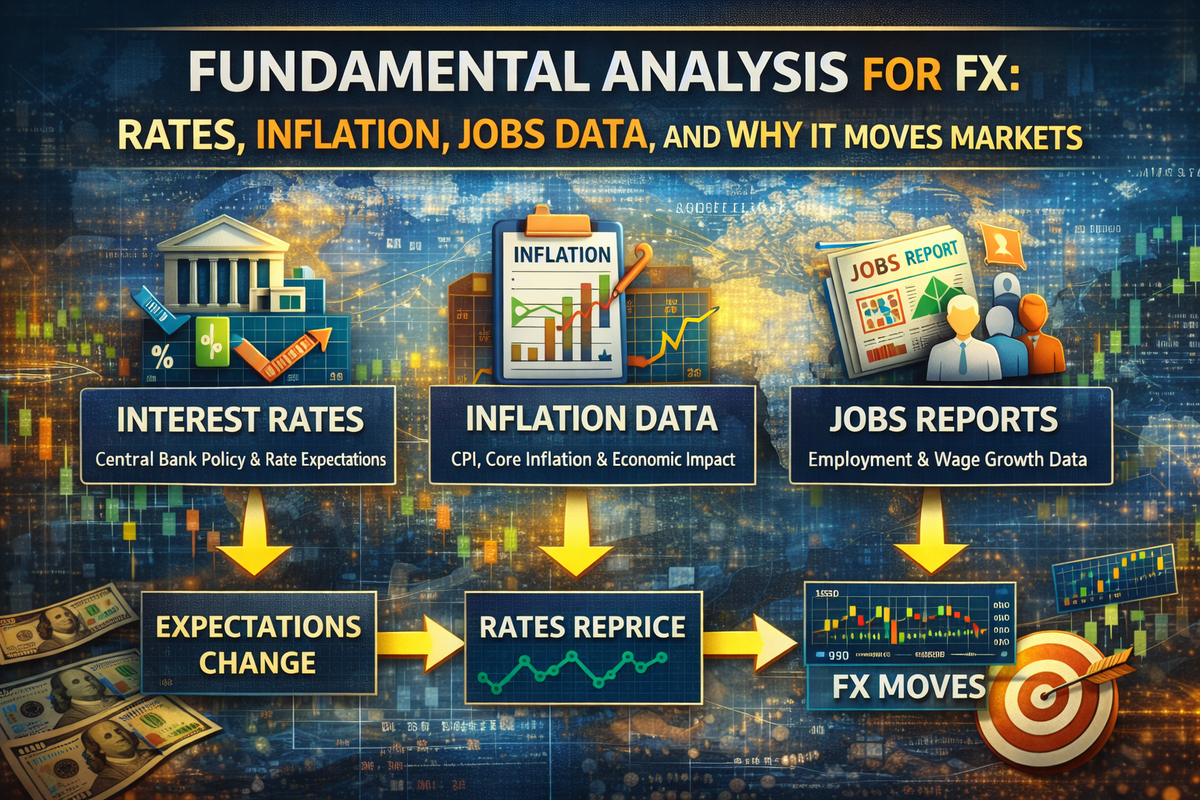
Data → changes expectations → changes rate outlook → changes capital flows → moves currency
Interest Rates: The Primary Driver of FX Over Time
Interest rates sit at the center of fundamental FX analysis because they represent the return investors can earn holding one currency versus another.
If U.S. rates are expected to be higher than Eurozone rates, capital tends to flow toward USD assets, supporting USD strength. If those expectations flip, flows can reverse.
You do not need to trade bonds to trade FX. You need to understand that FX is pricing relative return and relative risk.
Rate differentials and why they matter
Many major FX trends are driven by widening or narrowing rate differentials.
When differentials widen in favor of a currency, that currency often strengthens, especially against low-yielders. When differentials narrow, the currency can weaken.
This is not a perfect rule, but it is a powerful backbone for understanding multi-week and multi-month moves.
Why “expected rates” matter more than current rates
Markets move on expectations. Traders care about where rates will be in six months, not where they are today. This is why central bank communication is crucial.
When a central bank turns more hawkish, the currency can strengthen even before any rate hike happens. When it turns more dovish, the currency can weaken even if the policy rate remains unchanged.
Central Banks: The Narrative Engines of FX
Central banks are the macro “quarterbacks.” They influence FX through:
Policy rates
Forward guidance
Balance sheet policy (QT/QE)
Inflation credibility
Perceived reaction function
A reaction function is how a central bank tends to respond to changing inflation and growth.
If a central bank is perceived to be more tolerant of inflation, its currency can weaken because investors expect looser policy. If it is perceived to be inflation-fighting and hawkish, its currency may strengthen.
The four central bank regimes traders must recognize
Hawkish tightening: rates rising or expected to rise, inflation fight dominant
Dovish tightening: rates rising but near end, growth risks rising
Hawkish easing: cutting slower than expected, inflation risk still present
Dovish easing: cutting faster than expected, growth deteriorating
FX often trends when two regions are in different regimes.
Inflation: The Data That Forces Central Banks to Act
Inflation matters because it influences policy decisions and real purchasing power. Persistent inflation pushes central banks toward tightening. Falling inflation opens the door to easing.
But inflation is also expectations-driven. Markets respond not only to the CPI print, but to what it implies for the next few meetings.
Headline versus core inflation
Headline inflation includes everything, including energy and food, and can swing. Core excludes volatile components and is often considered more informative for policy.
Markets watch both, but core often has greater impact on rate expectations, depending on the central bank’s focus.
Why inflation can move FX instantly
Inflation prints can quickly reprice:
The probability of hikes or cuts
The terminal rate (where rates may peak)
The timing of policy changes
Risk sentiment and equity reactions
Those repricings flow through yields and then into currency moves.
Jobs Data: Why Employment Reports Hit FX Hard
Employment is central because it reflects economic momentum and wage pressure.
A strong labor market can support consumer spending and keep inflation sticky through wages. That pressures central banks to remain hawkish. A weakening labor market can signal slowdown and reduce inflation pressure, opening the door to cuts.
The major employment releases FX traders should respect
In the U.S., the market typically focuses on:
Nonfarm Payrolls (NFP)
Unemployment rate
Average hourly earnings
Participation rate and revisions
The employment report is not one number. The mix matters.
Example interpretation logic:
If NFP is strong but wages cool and unemployment rises, the USD reaction can be mixed. If NFP is solid and wages accelerate, the market may price tighter policy and the USD may strengthen.
The “Big Three” Data Categories That Drive FX
For practical trading, you can simplify the macro world into three categories:
Rates and central bank expectations
Inflation path and inflation surprises
Growth and labor market momentum
Most major FX moves stem from shifts in one of these three.
Yield Differentials and the Link Between FX and Bonds
Yields matter because they represent expected return. Traders often watch government bond yields as a real-time proxy for rate expectations.
A useful framework:
If yields rise faster in Country A than in Country B, A’s currency often strengthens versus B, especially when that yield move reflects policy expectations rather than risk panic.
That said, risk sentiment can distort the relationship. In risk-off events, flows can favor the USD or JPY regardless of yield logic.
Risk Sentiment: The Driver That Can Override Data
Risk sentiment refers to the market’s appetite for risk.
In risk-on conditions, investors seek higher yield, growth assets, and often higher-beta currencies. In risk-off conditions, investors seek safety and liquidity, often supporting safe-haven currencies.
Risk sentiment can amplify or override data-driven moves, especially during geopolitical shocks, banking stress, or major equity selloffs.
A serious FX trader always asks:
Is this a macro trend move, or a risk sentiment move?
A Practical Fundamental Framework You Can Use Daily
You do not need a PhD. You need a system.
Step one: Identify the policy divergence
Which central bank is more hawkish or more dovish right now?
Step two: Identify the key driver this month
Is the market focused on inflation, jobs, growth, or something else?
Step three: Track expectations, not opinions
What is the market priced for next month and next quarter?
Step four: Map catalysts
Which data releases can change expectations?
Step five: Build scenarios
If data is hotter than expected, what happens to rate expectations and the currency?
If data is cooler than expected, what changes?
Step six: Use technicals for entry and invalidation
Fundamentals define the direction bias; technicals define the execution.
How to Read the Economic Calendar Like a Professional
Retail traders often glance at the calendar and trade randomly. Professionals use the calendar to manage risk.
A practical method:
Rank events by potential to shift rate expectations.
Know the timing and avoid entering right before major releases unless your strategy is built for it.
Understand consensus and recent trend.
Plan post-event execution rather than trying to “catch the spike.”
The key idea is that the minutes around high-impact releases are often not where most traders make money. Many professionals wait for the post-event structure to form.
How FX Actually Reacts to Data: The Five-Step Reaction Chain
A clean way to understand reactions:
Data prints
Market compares to expectations
Rates/yields reprice
Risk sentiment adjusts
Currency moves and then consolidates
If you watch only the headline number, you miss the true driver: the shift in rates and expectations.
Example 1: Hot Inflation Surprise and a Stronger Currency
Imagine CPI prints above expectations and core inflation accelerates. The market increases the probability of rate hikes and pushes expected rates higher. Yields rise. The currency strengthens as capital flows seek higher return and tighter policy credibility.
In charts, you may see a breakout or a strong trend day. The serious trader does not chase blindly. They wait for a retest or a structure confirmation aligned with the new macro impulse.
Example 2: Weak Jobs Data and a Weaker Currency
Imagine employment data misses expectations, unemployment rises, and wage growth slows. The market prices earlier cuts. Yields drop. The currency weakens.
If risk sentiment is also deteriorating, reactions can be complex. For example, the USD can weaken due to lower yields, but can also strengthen if the move triggers risk-off flows into USD liquidity. This is why context matters.
Why “Good News” Can Be Bearish and “Bad News” Can Be Bullish
Markets are about pricing.
If the market is already positioned for great data, great data can cause little movement or even reversals due to profit-taking. If the market fears weak data and the result is “less bad,” the currency can strengthen.
A serious trader learns to ask:
Was this outcome already priced in?
Did the data change rate expectations meaningfully?
Fundamental Mistakes That Cost Traders Money
Treating data as isolated numbers rather than expectation shifts
Trading every news release without a plan
Ignoring the central bank narrative and reaction function
Forcing trades when volatility is abnormal
Holding positions through high-impact releases without sizing down
Believing one report overrides a multi-month trend without confirmation
Fundamental analysis is not about reacting to everything. It is about understanding which variables matter right now.
How to Combine Fundamentals with Technical Analysis
The professional combination looks like this:
Use fundamentals to set bias and filter trades.
Use technicals to define levels, entry triggers, and invalidation.
Use risk management to ensure one event cannot destroy your account.
Example approach:
If your macro bias favors USD strength because the Fed is more hawkish than peers, you prioritize setups that align with USD strength and you avoid fighting the trend unless there is clear evidence of a regime shift.
This reduces random trades and increases the quality of your sample.
A Simple “FX Macro Dashboard” You Can Maintain
To keep fundamentals practical, track:
Central bank stance and next meeting dates
Inflation trend and next CPI date
Jobs trend and next employment date
Key growth indicators relevant to the current narrative
Yield direction and major risk sentiment shifts
You do not need constant updates. You need consistency.
Frequently Asked Questions
Do I need fundamentals to trade intraday?
Not always, but fundamentals heavily influence intraday volatility and trend. Even technical traders benefit from knowing the event calendar and the macro bias, especially for USD pairs and gold.
Which data matters most for forex?
Over time, rates and rate expectations are the biggest driver. Inflation and jobs data matter most because they move rate expectations. In certain periods, growth data or geopolitical risk can temporarily dominate.
How do I avoid getting whipsawed around news?
Do not enter right before high-impact releases unless you have a tested news strategy. Consider waiting for post-event structure, widening stops and reducing size if you trade volatile windows, and always respecting daily loss limits.
Why does the market sometimes reverse after the first reaction?
Because positioning, liquidity, and profit-taking can dominate the immediate spike. The first move is often emotional and thin-liquidity driven. Acceptance and follow-through are what matter.
Conclusion: Fundamentals Explain the “Why,” Technicals Define the “How”
Forex fundamental analysis is not complicated when you focus on the few variables that matter most:
Rates and expectations
Inflation path
Jobs and wage pressure
Central bank reaction function
Risk sentiment and positioning
If you build a simple routine that tracks these drivers and you execute with technical discipline and defined risk, you stop trading headlines and start trading macro structure.
Comments ()