From Trader to Investor: Building a Portfolio While Actively Trading
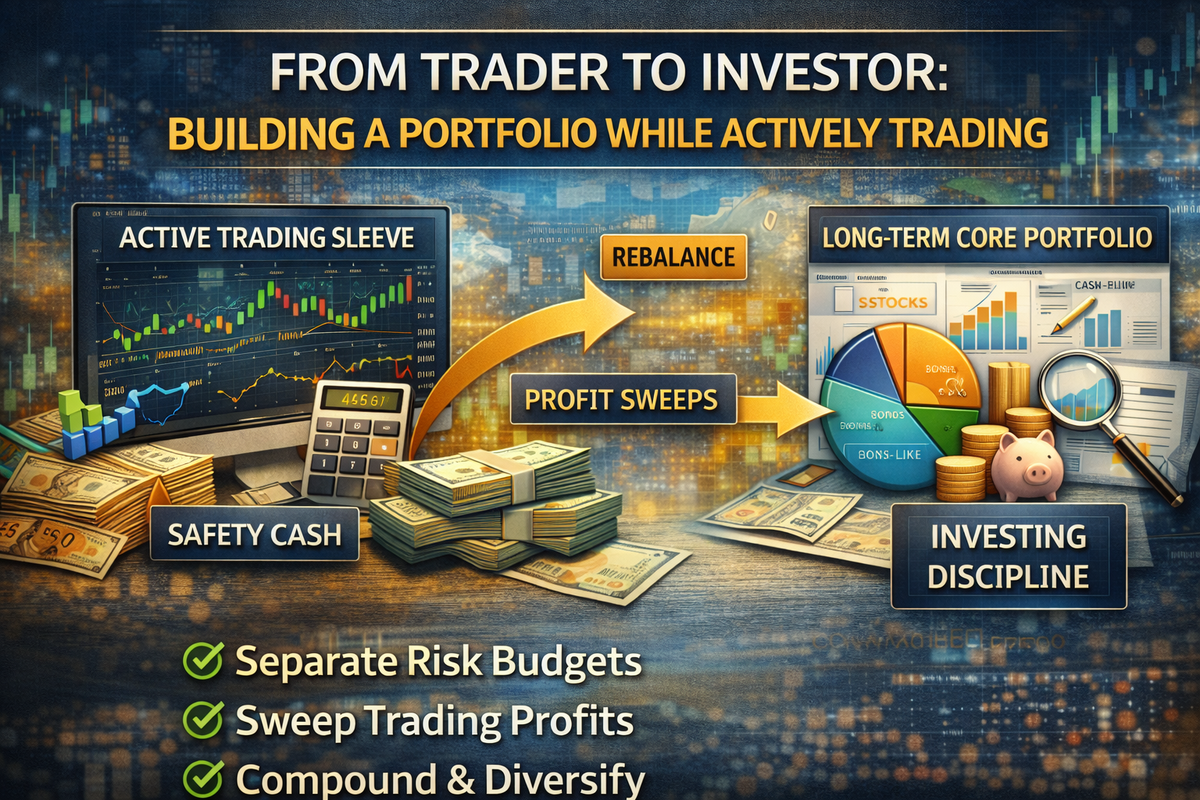
The core problem: trading income isn’t the same as wealth
Many traders experience a frustrating pattern: they can generate winning periods, yet their net worth barely grows. The reason is structural. Trading is typically cashflow-like and episodic, while wealth-building is compounding-like and systematic. Without a portfolio framework, profits stay trapped inside a high-variance activity.
A serious “Trader → Investor” transition is not about quitting trading. It is about building an operating system where:
Trading becomes a satellite engine for opportunity, and
Investing becomes the core engine for compounding and stability.
This is how many professionals and disciplined retail traders create long-term financial momentum.
A reality check: why you need a portfolio even if you trade well
Two evidence-based reasons to build an investing core:
Active trading tends to underperform once you account for costs, turnover, and behavior. A classic study of individual investors found that the most active traders earned materially lower returns than the market over the sample period, with trading costs and poor timing contributing to underperformance.
Most active fund managers underperform their benchmarks over time. The SPIVA scorecards repeatedly show large proportions of active managers underperforming their index benchmarks, reinforcing how difficult consistent outperformance is once costs are included.
This is not an argument against trading. It is an argument for not making your entire financial future depend on it.
Think in “portfolio architecture,” not in account balances
A trader’s mindset is often single-account: “How big is my trading account?” An investor’s mindset is multi-bucket: “How is my total capital allocated across goals, time horizons, and risk?”
A practical architecture that works for most serious market participants is a core-satellite model:
Core: long-term diversified holdings designed to compound
Satellite: your active trading sleeve (forex, gold, short-term strategies)
Optional: Cash buffer and opportunistic sleeve for special situations
The core-satellite concept is widely used because it aims to balance diversification and cost efficiency while still allowing targeted active risk.
The Portfolio Operating System (POS): a clear model you can run
1) The four buckets (simple, effective, scalable)
Bucket A: Safety cash (0–12 months needs)
Purpose: prevent forced selling and reduce emotional pressure.
Contents: cash, high-quality short-duration instruments (depending on your jurisdiction and risk tolerance).
Bucket B: Core compounding (3–20+ years)
Purpose: long-term growth and wealth building through diversification, rebalancing, and low friction.
Contents: diversified equity exposure (global), bonds/fixed income (appropriate to risk profile), possibly alternatives depending on sophistication.
Vanguard’s principles emphasize that diversification and costs are foundational to long-term investment outcomes.
Bucket C: Trading sleeve (active risk capital)
Purpose: generate opportunistic returns with strict risk rules and a defined maximum drawdown budget.
Contents: your forex/gold strategies, short-term systems, tactical trades.
Bucket D: Opportunity sleeve (optional, small)
Purpose: rare, high-conviction opportunities you can size responsibly (e.g., a specific theme, a single stock idea, or a hedging program).
Rule: keep this small enough that being wrong doesn’t damage the core.
2) Sample allocations (pick one and adjust over time)
These are not recommendations, just frameworks you can adapt:
Conservative trader-investor
Safety cash 15–25%
Core 60–75%
Trading sleeve 5–15%
Opportunity sleeve 0–5%
Balanced trader-investor
Safety cash 10–20%
Core 60–70%
Trading sleeve 10–20%
Opportunity sleeve 0–10%
Aggressive trader-investor (high skill + high discipline required)
Safety cash 5–15%
Core 50–65%
Trading sleeve 15–30%
Opportunity sleeve 0–10%
If you are still proving consistency, the fastest way to protect your future is usually: bigger core, smaller trading sleeve, lower risk per trade.
Why the “core” should be boring (and that’s the point)
Your core portfolio should be designed so that it does not require genius. It should be built around:
Asset allocation (the mix of stocks, bonds, cash-like assets)
Broad diversification (avoid concentration risk)
Low costs (because costs compound negatively)
Discipline and rebalancing (keep the risk profile stable over time)
A widely cited body of research highlights that asset allocation is a major driver of portfolio return variation, which is why getting the mix right matters more than constantly chasing “the next trade.”
The rule that makes the whole system work: separate risk budgets
A portfolio becomes durable when you assign risk budgets to each sleeve.
Core risk budget (long-term)
Define what drawdown you can tolerate without panicking. Examples:
“I can tolerate a 15–20% peak-to-trough drawdown.”
“I need lower volatility; I can tolerate 10–12% drawdown.”
Then choose an allocation consistent with that reality.
Trading risk budget (short-term)
Define maximum damage the trading sleeve can do to your overall finances:
Hard ceiling approach (recommended):
“My trading sleeve must never exceed X% of my total liquid net worth.”
Example: 15%.
Drawdown circuit-breaker approach:
“If my trading sleeve is down 10–15%, I reduce risk by half.”
“If it is down 20%, I pause and review before continuing.”
These rules turn trading into a controlled experiment rather than an uncontrolled emotional spiral.
The “profit sweep” mechanism: how traders become investors automatically
The biggest mistake traders make is leaving profits inside the same risk engine that produced them. A professional approach is to systematically export profits into the core.
Two robust profit sweep models:
Monthly sweep (simple and effective)
At month-end, withdraw a fixed percentage of profits (e.g., 30–70%) into the core portfolio.
Equity high-water sweep (more professional)
When the trading account hits a new equity high, sweep a portion above the previous high-water mark into the core.
This prevents “house money effect” behavior, where traders become reckless after winning streaks.
Rebalancing: the investor’s discipline tool
Even a well-designed core drifts. If equities rally, you become overexposed to equities. If bonds fall, your defensive sleeve shrinks. Rebalancing restores your intended risk profile.
A practical rule used by many disciplined investors:
Rebalance quarterly or semiannually, or when weights drift by ~5% absolute from target.
Vanguard describes rebalancing as maintaining the mix that’s right for you and avoiding costly, emotionally driven drift.
Rebalancing is one of the simplest ways to “buy low, sell high” without trying to predict.
How to run trading and investing at the same time without sabotaging either
Separate your accounts (and your identity)
Use distinct accounts or at least distinct tracking:
Core account: long-term rules, minimal tinkering
Trading account: short-term rules, strict risk controls, higher turnover
This separation protects you from blending time horizons (one of the fastest ways to lose money).
Match instruments to the sleeve
High-turnover and leveraged products belong in the trading sleeve, not the core. The core benefits from lower turnover and lower costs because friction compounds over time.
Avoid hidden correlation
If your trading revolves around USD themes (common in FX and gold), your core portfolio may also be implicitly USD-heavy depending on equity exposure. Build awareness of what you’re already “long” in your life and portfolio.
A concrete example: £50,000 total capital, active FX + gold trader
This is an educational example to show mechanics, not a recommendation.
Total available capital: £50,000
Chosen model: Balanced
Safety cash: 15% = £7,500
Core: 65% = £32,500
Trading sleeve: 15% = £7,500
Opportunity sleeve: 5% = £2,500 (optional; can be rolled into core)
Trading rules inside the £7,500 sleeve:
Risk per trade: 0.5% of trading sleeve (£37.50 risk per trade)
Max daily loss: 2R (£75)
Max weekly loss: 6R (£225)
Profit sweep: 50% of monthly profits into core
Outcome:
Even if the trader hits a rough patch, the damage is contained. If the trader performs well, profits are systematically converted into compounding assets.
UK-specific note: use tax wrappers intelligently (2025/26)
If you are UK-based, structuring the core inside tax-advantaged wrappers can materially improve outcomes over time.
ISA allowance: the annual ISA subscription limit is £20,000 (example shown for the 2025 to 2026 tax year on GOV.UK).
Pension annual allowance: GOV.UK lists the annual allowance as £60,000 for the 2025 to 2026 tax year (subject to tapering and other rules).
Practical principle:
Put your long-term compounding assets where they receive the best tax treatment available to you, and keep high-turnover trading activity compartmentalized.
The most common “Trader → Investor” mistakes (and how to avoid them)
Mistake: treating the trading account as the portfolio
Fix: define a core target allocation and fund it automatically via profit sweeps.
Mistake: building a core of random trades
Fix: core should be diversified, rules-based, and low-maintenance.
Mistake: chasing performance with constant changes
Fix: use a rebalancing policy and stick to it.
Mistake: scaling trading risk because of confidence
Fix: scale only after verified performance and keep trading sleeve capped as % of total net worth.
Mistake: ignoring costs and turnover
Fix: keep the core low-friction; recognize that trading frequency and costs can degrade results.
A simple 30–60–90 day implementation plan
Days 1–30: Build structure
Define your buckets and target allocations.
Set trading sleeve cap as % of your net worth.
Write your profit sweep rule.
Days 31–60: Automate discipline
Automate contributions to the core (monthly).
Implement rebalancing rules (calendar or threshold).
Start journaling portfolio decisions, not only trades.
Days 61–90: Optimize and simplify
Review: is your trading sleeve helping, or creating stress?
Adjust risk per trade if rule compliance is weak.
Refine the core so it requires less attention, not more.
Comments ()