EUR/USD Playbook: Key Drivers, Best Setups, Common Traps

The EUR/USD currency pair stands as the most actively traded instrument in global foreign exchange markets, accounting for approximately 24% of daily forex trading volume. This liquidity and market depth make it an attractive opportunity for traders worldwide, yet success in trading this pair requires understanding the fundamental drivers that move prices, recognizing high-probability technical setups, and avoiding the psychological and strategic traps that ensnare even experienced market participants.
Understanding EUR/USD: The World's Most Liquid Currency Pair
EUR/USD represents the exchange rate between the Euro and the United States Dollar, showing how many dollars are required to purchase one euro. The pair's exceptional liquidity creates tight spreads and consistent price action, making it suitable for various trading strategies from scalping to swing trading. The combination of two major economic zones—the Eurozone and the United States—ensures constant market activity and responsiveness to global economic developments.
Key Fundamental Drivers of EUR/USD
Central Bank Monetary Policy
The primary force driving EUR/USD movements is the divergence or convergence in monetary policy between the European Central Bank and the Federal Reserve. Interest rate differentials between these institutions create powerful directional trends that can persist for months or years.
When the Federal Reserve maintains higher interest rates relative to the ECB, capital flows typically favor the dollar as investors seek superior returns on dollar-denominated assets. Conversely, when the ECB holds rates steady while the Fed cuts, the euro tends to strengthen as the yield advantage narrows. Markets in 2026 expect the ECB to remain on hold throughout the year while the Fed implements at least three rate cuts, creating compelling reasons for EUR/USD appreciation.
The market pricing of future rate changes often precedes actual policy adjustments, meaning EUR/USD frequently moves in anticipation of central bank decisions rather than reacting to them after announcement. Traders must monitor not only official interest rate decisions but also forward guidance, monetary policy statements, and central banker speeches that signal future policy direction.
Economic Data Releases
High-impact economic indicators serve as catalysts for EUR/USD volatility, particularly during key release windows. The most significant data points include:
United States Employment Data: The Non-Farm Payrolls report, released on the first Friday of each month, consistently generates substantial price movements in EUR/USD. NFP releases almost always cause market volatility and can either support or undermine the US dollar depending on whether actual figures exceed or fall short of expectations. The August 2025 NFP report showed only 22,000 jobs added, missing the 75,000 consensus by a wide margin and triggering significant dollar weakness.
Inflation Metrics: Both headline and core inflation readings influence central bank policy expectations. The Harmonized Index of Consumer Prices for the Eurozone and the Consumer Price Index for the United States directly impact EUR/USD as markets adjust rate cut or hike probabilities. If eurozone inflation rises above the ECB's 2% target, it creates pressure for tighter monetary policy that supports the euro.
GDP Growth Figures: Economic growth differentials between the United States and Eurozone drive longer-term EUR/USD trends. Stronger US growth trajectory and higher return on capital have historically supported the dollar, while improving eurozone demand can bolster the euro.
Purchasing Managers Indices: Monthly PMI releases for manufacturing and services sectors provide forward-looking indicators of economic health. A decline in US services PMI signals downturn in the services sector and can weaken the dollar against the euro.
Geopolitical Events and Risk Sentiment
Global uncertainty and risk appetite shifts significantly influence EUR/USD behavior. Major geopolitical developments, unexpected policy announcements, and financial market shocks create rapid repricing in currency markets. The 2015 Swiss National Bank decision to abandon its euro peg exemplifies how unexpected central bank actions can generate massive currency dislocations.
The US dollar's status as a safe-haven currency means EUR/USD often declines during periods of heightened global risk, as capital flows toward dollar assets seeking safety. Conversely, risk-on environments typically support the euro as investors rotate into higher-yielding and growth-sensitive assets.
Cross-Currency Influences
EUR/USD does not trade in isolation from other currency pairs. Research indicates that the euro is influenced relatively more by EUR/GBP and other European cross rates than many traders realize. Additionally, Australian interest rates affect AUD/USD trends more than interest rate differentials alone, suggesting complex interconnections across forex markets.
Optimal Trading Times for EUR/USD
London and New York Session Overlap
EUR/USD exhibits its highest liquidity and volatility during specific trading windows aligned with major financial center operating hours. The optimal period for trading EUR/USD occurs during the London-New York session overlap from 12:00 PM to 4:00 PM GMT. This four-hour window combines the trading volumes of both major markets, resulting in tighter spreads and greater price movements.
Individual Session Characteristics
London Session (7:00 AM to 4:00 PM GMT): As Europe's primary financial hub, London trading brings substantial EUR/USD volume and establishes key intraday directional moves.
New York Session (12:00 PM to 8:00 PM GMT / 8:00 AM to 5:00 PM EST): Accounting for approximately 17% of total daily forex trading volume, the New York session introduces high liquidity and market volatility, especially during its overlap with London.
Tokyo and Sydney Sessions: While EUR/USD trades 24 hours, the Asian sessions typically exhibit lower volatility and wider spreads as both the euro and dollar are not the primary currencies in these time zones.
The standard trading window for EUR/USD with peak activity spans 1:00 PM to 9:00 PM GMT, with the most active period concentrated between 12:00 PM and 4:00 PM GMT. Traders should align their strategies with these timeframes, reserving high-frequency and scalping approaches for the overlap period while employing longer-timeframe strategies during quieter sessions.
Best EUR/USD Trading Setups
Technical Analysis Framework
Successful EUR/USD trading integrates multiple technical approaches to identify high-probability entry and exit points.
Support and Resistance Levels
Identifying key horizontal support and resistance zones forms the foundation of technical EUR/USD trading. Recent analysis highlights critical levels including:
- Support Zone 1: 1.1577 - 1.1600 area serving as reliable demand zone
- Support Zone 2: 1.1445 - 1.1458 area providing secondary support
- Resistance Zone 1: 1.1682 - 1.1766 area capping upside attempts
- Resistance Zone 2: 1.1807 - 1.1830 area representing major overhead resistance
The 1.16 support level has consistently absorbed selling pressure while resistance near 1.18 caps upside moves, creating a defined trading range. Traders can structure range-bound strategies by buying near support and selling near resistance, or prepare breakout strategies for moves beyond these boundaries.
Trend-Following Strategies
EUR/USD frequently develops sustained directional trends lasting weeks or months, creating opportunities for trend-following approaches. Moving averages serve as dynamic support and resistance levels that guide trend identification:
- 200-day Moving Average: Currently at 1.14965, this long-term average has provided solid support since March 2025, confirming the broader uptrend
- 50-day Moving Average: At 1.16088, the recent breakout above this average reaffirms upward momentum
- 52-week Moving Average: Trading well above the uptrending 52-week MA at 1.12791 on the weekly chart displays strong bullish pattern
The presence of ascending bottoms at 1.10649, 1.13916, and 1.14686 alongside uptrending moving averages supports a "buy the dip" strategy that has proven effective since March 2025.
Breakout Trading
Breakout strategies focus on identifying consolidation zones and trading momentum increases when price escapes these ranges. This approach suits high-volatility trading sessions and can apply across multiple timeframes from scalping to swing trading.
Effective breakout trading requires:
- Identifying well-defined trading ranges with clear support and resistance boundaries
- Awaiting confirmed breakouts with increased volume
- Entering partial positions at initial breakout with additions during first minor retracement to manage timing risk
Range-Bound Trading
When EUR/USD lacks strong directional trends, range-bound strategies utilizing support and resistance zones become optimal. This approach works best when combined with oscillators like Relative Strength Index and Stochastics that identify overbought and oversold conditions within the range.
Range traders buy near established support levels with stops below support, targeting resistance zones for profit-taking. Conversely, they sell near resistance with stops above, targeting support for exits.
Technical Indicators for EUR/USD
Moving Averages
Simple Moving Averages and Exponential Moving Averages provide trend direction, dynamic support/resistance, and crossover signals. Traders commonly employ 20-period, 50-period, and 200-period moving averages across various timeframes.
Relative Strength Index (RSI)
RSI identifies momentum conditions and potential reversal zones. Values above 70 suggest overbought conditions potentially preceding downward corrections, while readings below 30 indicate oversold conditions that may precede rebounds. Divergences between price action and RSI provide early reversal warnings.
Average True Range (ATR)
ATR measures market volatility, helping traders adjust position sizing and set appropriate stop-loss distances. Higher ATR readings during news releases or session overlaps indicate increased volatility requiring wider stops, while lower readings during quiet sessions allow tighter risk parameters.
Fibonacci Retracement Levels
Fibonacci analysis identifies potential reversal zones during pullbacks within established trends. Key retracement levels at 38.2%, 50%, and 61.8% frequently align with significant support or resistance, providing entry opportunities for trend continuation trades.
Fundamental Trading Strategies
Central Bank Event Trading
Positioning ahead of Federal Reserve and ECB policy announcements represents a higher-risk, potentially higher-reward approach. Traders analyze pre-meeting economic data, central banker speeches, and market positioning to anticipate policy decisions and forward guidance.
The risk lies in unexpected outcomes that trigger sharp reversals. The reward emerges when correctly anticipating policy shifts before broader market consensus forms.
Economic Calendar-Based Trading
Systematic trading around scheduled economic releases like NFP, GDP, inflation, and PMI data creates structured opportunities. This approach requires:
- Identifying high-impact events via economic calendar
- Analyzing consensus expectations versus recent trends
- Preparing trade scenarios for above-consensus, in-line, and below-consensus outcomes
- Managing risk through appropriate position sizing given expected volatility spikes
Interest Rate Differential Trading
Longer-term position traders capitalize on sustained interest rate differential trends between the Fed and ECB. When rate differentials compress, growth and capital flows become swing factors favoring the currency with superior economic performance.
For 2026, narrowing policy rate differentials and reduced US monetary policy premium create supportive conditions for EUR strengthening. However, stronger US growth trajectory and higher return on capital provide offsetting USD support.
Common EUR/USD Trading Traps and How to Avoid Them
Ignoring Market News and Economic Releases
Trading EUR/USD based solely on technical charts without monitoring economic reports and geopolitical developments resembles sailing without a map. Global events, economic data, and political shifts substantially impact currency prices, yet many traders focus exclusively on technical patterns.
Major news events consistently generate volatility that invalidates technical setups. The 2015 Swiss National Bank surprise decision to abandon its euro peg sent shockwaves through forex markets, inflicting massive losses on traders unaware of the development.
Solution: Maintain awareness of the economic calendar, monitor central bank communications, and track geopolitical developments. Avoid initiating new positions immediately before high-impact releases unless specifically trading the event with appropriate risk management.
Overleveraging Positions
Excessive leverage amplifies both gains and losses, representing one of the most destructive mistakes in forex trading. While forex brokers may offer leverage up to 50:1 or higher, using maximum available leverage exposes accounts to rapid depletion during normal market volatility.
A trader risking 10% of account equity per trade with 50:1 leverage can lose their entire account with a 5% adverse price movement. EUR/USD routinely experiences 1-2% daily ranges during volatile periods, making overleveraged positions extremely vulnerable.
Solution: Limit risk to 1-2% of account equity per trade regardless of available leverage. Calculate position size based on account size, risk tolerance, and stop-loss distance rather than maximum available leverage. Use position sizing calculators to determine appropriate lot sizes.
Revenge Trading After Losses
Revenge trading—entering impulsive trades to quickly recover losses—ranks among the biggest psychological mistakes traders make. After experiencing a losing trade, the emotional reaction to immediately enter another position without proper analysis typically compounds losses rather than recovering them.
This behavior stems from neurological responses where the brain seeks emotional relief rather than logical trading decisions. Loss aversion causes humans to feel losses approximately twice as intensely as equivalent gains, triggering urgency to "make it all back".
Example scenario:
- Trader takes loss on EUR/USD position
- Immediately enters XAUUSD trade without analysis
- Over-leverages to recover losses quickly
- Trade moves adversely, creating even larger losses
- Cycle repeats, transforming small loss into blown account
Solution: Establish pre-defined rules for handling losses. Step away from trading screens after significant losses. Maintain trading journal documenting emotional states alongside trade decisions. Accept that losses are inherent to trading and focus on process rather than individual outcomes.
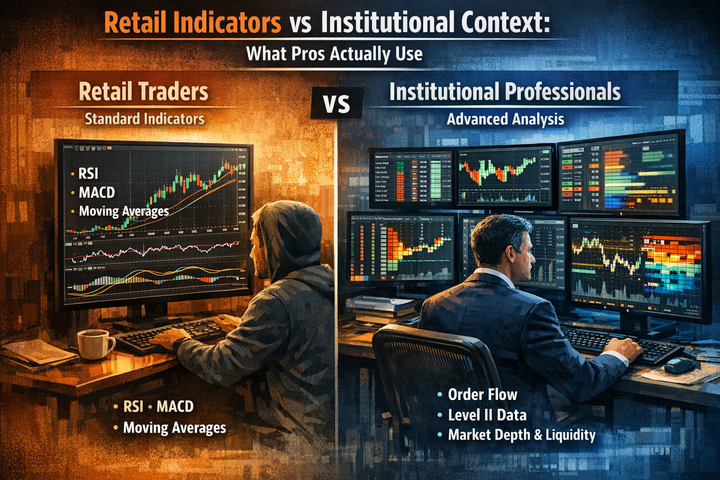
Strategy Hopping and Indicator Overload
Constantly switching strategies or adding indicators after one or two losses creates inconsistency and prevents traders from building accounts according to verified rules. Successful trading requires consistent repetition of proven approaches, similar to athletic performance.
Adding multiple indicators to "fix" problems typically generates conflicting signals and analysis paralysis. Each indicator provides different information, and excessive indicators create confusion rather than clarity.
Solution: Select a trading strategy aligned with personality, risk tolerance, and time availability. Thoroughly backtest the approach across various market conditions. Commit to executing the strategy consistently for minimum sample size of 30-50 trades before evaluating performance. Limit indicators to 2-3 complementary tools rather than overwhelming charts with redundant information.
Poor Risk Management and Position Sizing
Failing to implement systematic risk management destroys trading accounts even when directional bias proves correct. Without predetermined stop-losses and position sizing aligned with account equity, single trades can inflict catastrophic damage.
The relationship between stop-loss size and position size is inverse: larger stop-losses require smaller position sizes to maintain consistent risk levels. A trader with 20-pip stop-loss can utilize larger position size compared to 200-pip stop-loss for identical risk amount.
Position Sizing Formula:
Position Size = Risk Amount / (Stop Loss in Pips × Value per Pip)
Example:
- Account size: $10,000
- Risk per trade: 1% = $100
- Stop loss: 200 pips
- Value per pip (1 micro lot EUR/USD): $0.10
Position size = 100 / (200 × 0.10) = 5 micro lots
Solution: Calculate position size for every trade based on predetermined risk percentage (typically 1-2% of account). Place stop-losses strategically using support/resistance levels, volatility measurements, and trend analysis rather than arbitrary distances. Use trailing stops to lock in profits as price moves favorably.
Trading Without Defined Plan
Entering positions without clear entry criteria, profit targets, and exit rules leads to inconsistent results and emotional decision-making. A comprehensive trading plan provides structure and removes real-time uncertainty about trade management.
Solution: Develop detailed trading plans that specify:
- Market conditions suitable for strategy deployment
- Precise entry trigger criteria
- Initial stop-loss placement methodology
- Profit target calculations or trailing stop rules
- Position sizing aligned with risk parameters
- Maximum daily/weekly loss limits
Document the plan in writing and review it before each trading session to maintain discipline.
Neglecting Multiple Timeframe Analysis
Focusing exclusively on single timeframe creates incomplete market perspective and increases probability of trading against larger trends. EUR/USD may display bullish setup on 15-minute chart while 4-hour and daily charts show strong downtrends.
Solution: Analyze multiple timeframes before initiating trades. Use longer timeframes (daily, 4-hour) to identify dominant trend and key support/resistance zones. Employ shorter timeframes (1-hour, 15-minute) to refine entry timing within the context of larger trend. Align trade direction with higher timeframe momentum to improve probability of success.
EUR/USD Outlook and Strategic Considerations
2026 Market Projections
Major financial institutions project EUR/USD appreciation into the 1.20-1.25 range during 2026 as Fed easing, softer US growth, and improving eurozone fundamentals drive weaker dollar trends. Goldman Sachs maintains one of the most bullish forecasts at 1.25, citing fading US exceptionalism and persistent diversification away from dollar assets.
The deteriorating performance of US equities for EUR-based investors—down 8% in 2025 after currency adjustment—serves as catalyst for renewed interest in European markets. With the 200-day moving average providing solid support and recent breakout above the 50-day moving average, EUR/USD begins 2026 positioned to challenge the yearly high at 1.19188.
Balancing Bullish and Bearish Factors
Supportive Factors for EUR:
- Narrowing policy rate differentials as Fed cuts while ECB holds
- Reduced US monetary policy premium
- Less asymmetric central bank risk
- Improved eurozone economic momentum
Supportive Factors for USD:
- Stronger US growth trajectory
- Higher return on capital in US markets
- Deeper and more flexible US financial markets
- Safe-haven demand during risk-off periods
The balance between these factors will determine whether EUR/USD reaches the optimistic 1.25 projections or faces resistance from US economic outperformance.
Risk Scenarios
Traders must prepare for scenarios outside base case projections:
Bearish EUR/USD Scenario: Earlier and deeper ECB rate cuts relative to Federal Reserve, weak eurozone growth momentum, and cooling inflation providing policy easing room could structurally favor USD through unfavorable rate differentials.
Bullish EUR/USD Scenario: Fading European political risks, stabilizing global growth, and continued dollar diversification by central banks and institutional investors could propel EUR/USD toward multi-year highs above 1.23496.
Implementing Your EUR/USD Trading Plan
Success in EUR/USD trading requires integrating fundamental analysis, technical setups, optimal timing, and disciplined risk management into cohesive strategy. Traders should:
- Monitor Central Bank Policy: Track Fed and ECB communications, rate decisions, and forward guidance as primary directional drivers
- Maintain Economic Calendar Awareness: Prepare for high-impact releases like NFP, inflation data, and GDP figures
- Identify High-Probability Technical Setups: Utilize support/resistance levels, trend analysis, and confirmation indicators
- Trade During Optimal Sessions: Focus activity during London-New York overlap for maximum liquidity and tighter spreads
- Implement Strict Risk Management: Limit risk to 1-2% per trade with position sizing aligned to stop-loss distance
- Avoid Psychological Traps: Resist revenge trading, strategy hopping, and overleveraging impulses
- Maintain Trading Journal: Document all trades, rationale, emotions, and outcomes to identify patterns and improve performance
EUR/USD offers exceptional opportunities for informed traders who understand the interplay between fundamental drivers and technical price action. The pair's liquidity, tight spreads, and responsiveness to economic developments create favorable trading environment across various timeframes and strategies. By mastering the key drivers, recognizing optimal setups, and avoiding common traps, traders can develop sustainable edge in the world's most actively traded currency pair.


Comments ()