
XAU/USD Daily Signal & Deep Market Analysis — Tuesday, 10 March 2026
📡 Live Price Check
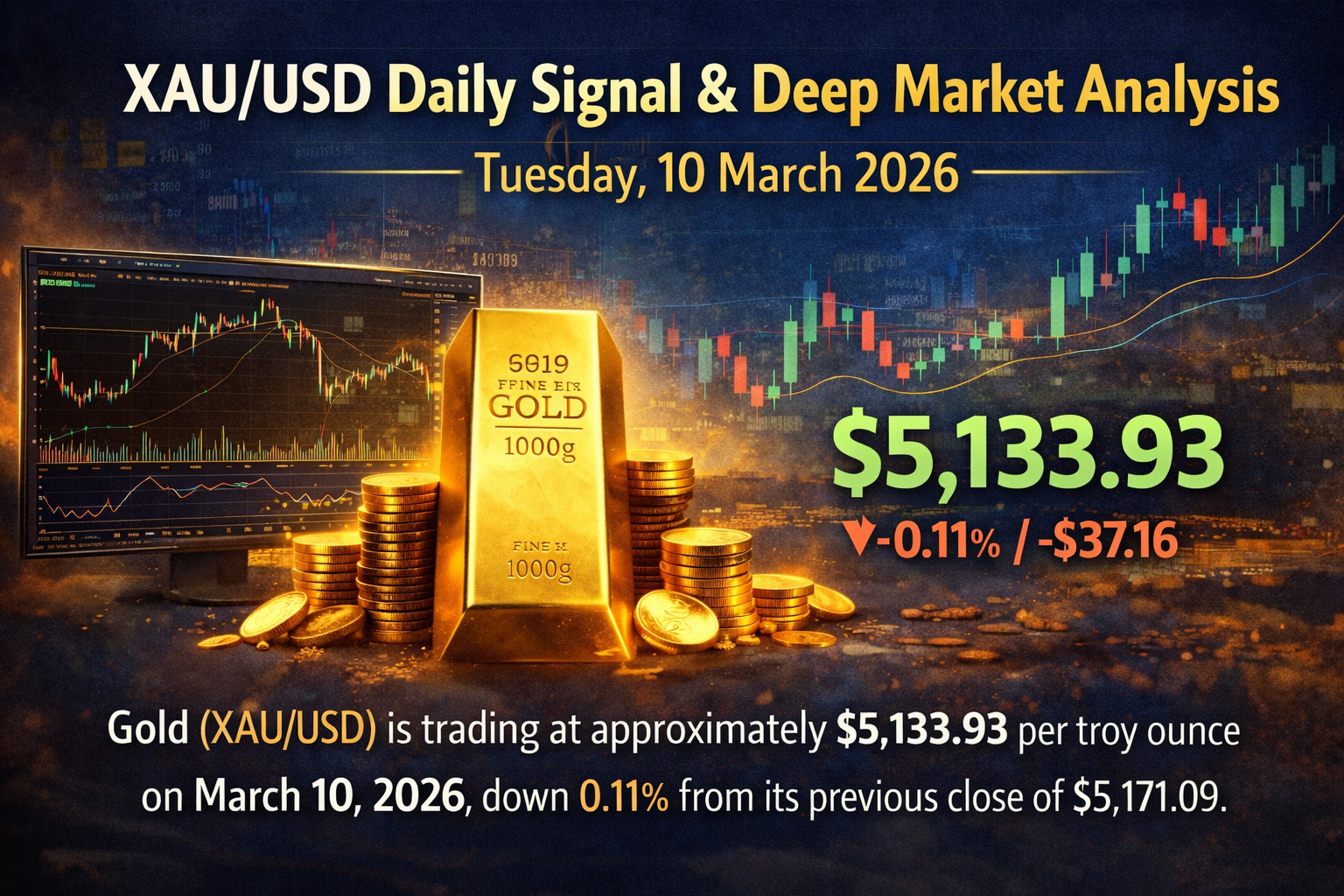
Gold (XAU/USD) is trading at approximately $5,133.93 per troy ounce on March 10, 2026, down 0.11% from its previous close of $5,171.09. Intraday data confirms an opening around $5,141.90 with a minor high of $5,149.40, suggesting early Asian/European session selling pressure. This places the price firmly inside the broader consolidation range of $4,950–$5,350 that has characterised trading since late February.
📊 Today's Trading Signal
| Parameter | Level |
|---|---|
| Signal Bias | ⚠️ CAUTIOUS BUY (Conditional) |
| Current Price | ~$5,133–$5,140 |
| Entry Zone | $5,095–$5,130 (on any intraday dip) |
| Take Profit 1 (TP1) | $5,186–$5,203 |
| Take Profit 2 (TP2) | $5,247–$5,264 |
| Stop Loss | $4,985 (firm close below $5,000 invalidates the setup) |
| Risk/Reward | ~1:1.6 to TP1 / 1:2.7 to TP2 |
| Signal Confidence | 🟡 Medium-High (65–70%) |
| Timeframe | Daily Chart |
Conditional Trigger for Higher Confidence: A bullish daily (New York) close above $5,200 significantly upgrades this signal to a Strong Buy, targeting the $5,350–$5,418 zone. Until that breakout is confirmed, manage risk carefully and size conservatively.
🏗️ Technical Structure — Daily Chart
Moving Averages
Gold's daily chart structure remains fundamentally bullish. Price trades comfortably above both the 50-day SMA ($5,040.03) and the critically important 200-day SMA ($4,269.65). The coveted Golden Cross — where the 50-day SMA trades above the 200-day SMA — is firmly in effect, a long-term institutional bullish signal. The near-term soft spot is that price has been trading just below the 20-day EMA (~$5,133–5,150), which is acting as dynamic short-term resistance and indicates near-term selling pressure that needs to be overcome.
On the 4-hour chart, VWAP and the SMA20 remain slightly above market price, confirming that the intraday tone is one of residual selling pressure rather than outright accumulation. However, this is not unusual for a consolidation phase following a major trend move.
RSI (Relative Strength Index)
The 14-period RSI is currently in the range of 41–44, placing it in neutral-to-mildly-bearish territory on the daily chart. Importantly, RSI is rising off lower levels on the 4-hour chart, suggesting that momentum is recovering from the early-March sell-off that saw price briefly test $5,000. The RSI is not in overbought territory, meaning upside potential exists without immediate exhaustion risk.
MACD (Moving Average Convergence Divergence)
The MACD picture is nuanced and context-dependent. On the daily chart, MACD remains in positive territory at +40.33, affirming medium-term bullish momentum, though the trajectory is gradually weakening and momentum is fading. On the 4-hour chart, MACD has recently crossed above the zero line to the upside, which is a fresh short-term bullish signal confirming increasing buying pressure at current levels.
Stochastic Oscillator
The Stochastic is reading around 24.32 on the daily chart — approaching oversold conditions — and is turning down from the upper part of the recent range on shorter timeframes. Historically, a Stochastic reading below 20–25 on the daily chart represents a potential reversal opportunity, and a crossover back upward would reinforce the buy case.
CCI (Commodity Channel Index)
The CCI is at approximately -106.09, indicating bearish pressure in the short term. Values below -100 typically suggest a price has deviated negatively from its statistical average and can signal a mean-reversion buying opportunity. This reading aligns with the oversold Stochastic to build the case for a tactical daily bounce.
ADX (Average Directional Index)
The ADX is currently reading ~26, indicating that a trend exists but is not yet at full strength. A reading between 20–25+ suggests a developing trend phase. Given the prior strong rally structure and the current consolidation, this suggests the market is "reloading" rather than reversing.
ATR (Average True Range)
The ATR is currently at approximately $7 intraday for shorter timeframes but on a daily basis, gold has been experiencing swings of $100–$200 per session during key catalysts. This reinforces the importance of wide stop-loss levels (at minimum $100–$150 from entry) to avoid noise-induced stopouts. The $4,985 stop suggested above respects this volatility.
Bollinger Bands
Following the sharp correction from the $5,450–5,500 highs of late January/early February, the Bollinger Bands expanded dramatically and then began to contract during the consolidation phase. Price is currently trading in the middle-to-lower portion of the bands, consistent with a neutral consolidation environment with potential for an upward mean-reversion move.
Fibonacci Retracement
A critical technical observation: during the early March sharp sell-off, gold found its low precisely at $5,000, which coincides with the 50% Fibonacci retracement of the major rally from the autumn 2025 lows to the January 2026 highs near $5,450–5,500. The fact that this major psychological level and the 50% Fib level held is a textbook bullish signal, indicating that longer-term institutional buyers stepped in at exactly the expected technical level.
🔑 Key Support & Resistance Levels
| Level | Zone | Type |
|---|---|---|
| $5,247–$5,264 | Daily R2 | Resistance |
| $5,186–$5,203 | Daily R1 | Resistance |
| $5,133–$5,150 | 20-day EMA / Session Pivot | Dynamic Resistance |
| $5,024–$5,041 | Daily S1 | Support |
| $5,000 | Psychological + 50% Fib | Strong Support |
| $4,963–$4,988 | Daily S2 | Support |
| $4,950 | Weekly structural floor | Key Support |
| $4,750 | Bear scenario target | Major Support |
| $5,350–$5,450 | Weekly resistance zone | Resistance |
🌍 Fundamental & Macro Analysis
Geopolitical Safe-Haven Demand (Primary Bullish Driver)
The dominant macro narrative driving gold is the active military conflict between the United States, Israel, and Iran. The US and Israel are conducting systematic strikes on Iranian military infrastructure, nuclear facilities, and ballistic missile capabilities. Iran has responded with missile attacks on neighbouring countries and energy infrastructure. This full-scale regional war has been the single largest driver of safe-haven demand for gold in the near term. The Strait of Hormuz — through which approximately 20% of global oil passes — has seen traffic fall by approximately 70%, sending crude oil (WTI) surging past $90 per barrel to multi-year highs. This conflict is not expected to resolve within days; analysts estimate it could run for several more weeks at minimum.
US Federal Reserve & Interest Rate Outlook
The rate environment has become more complex for gold in the short term. Last week's mixed US economic data — including a Non-Farm Payrolls miss by ~150,000 jobs and an Unemployment Rate tick higher to 4.4% — strengthened the argument for Fed rate cuts, which is traditionally bullish for gold. However, US Average Hourly Earnings rose 0.4% MoM (vs. 0.3% expected) and ISM Services PMI was strong, contributing to a hawkish undercurrent. The net result: the CME FedWatch tool now prices only one 0.25% cut in 2026, expected no earlier than September. Delayed cuts mean the dollar remains relatively supported in the near term, creating a headwind for gold. However, this has already been partially priced into the current consolidation.
US Dollar Index (DXY) — Key Counterweight
The DXY strengthened last week, benefiting from both the hawkish rate tilt and safe-haven flows into the dollar from Middle East war uncertainty. A stronger dollar typically weighs on gold prices as it makes dollar-denominated bullion more expensive for international buyers. However, it is important to note that gold and the dollar have been rising together during this conflict period — an unusual occurrence that signals the safe-haven premium for gold is so strong that it is overriding the traditional inverse correlation. The broader 2026 outlook for the DXY remains bearish as the Fed transitions toward a neutral regime, which supports gold's structural bull case.
Tariff Risk & Inflation
The US Treasury Secretary announced a proposed global 15% tariff that could come into effect imminently and remain in place for up to five months. This adds another inflationary layer to an already elevated inflation environment driven by surging energy prices from the Middle East conflict. Higher inflation erodes real yields and increases gold's attractiveness as a store of value. Analysts at CBS News reported that experts "largely agree that gold prices will continue rising in March," with portfolio manager Thomas Winmill of Midas Funds predicting prices of over $5,500/oz within one to two months, driven by strong central bank demand and dollar diversification.
Central Bank Demand (Structural Long-Term Bull Driver)
Central banks globally continue to purchase gold at record levels. According to the latest World Gold Council data, global gold demand hit a historic quarterly record of 1,313 tonnes in late 2025. Central banks — particularly those diversifying away from US Treasury securities — represent a structural and persistent bid under the market that places a floor under any meaningful corrections.
🔭 Scenario Analysis for Today
📈 Bullish Scenario (Primary, ~60% Probability)
Price holds above the $5,095–$5,100 intraday support zone. A recovery above the 20-day EMA (~$5,133–$5,150) during the London or New York session triggers short-covering and fresh longs. Price then rallies toward Daily R1 at $5,186–$5,203. A confirmed New York closing price above $5,200 would signal the resumption of the broader uptrend and target the $5,247–$5,264 (R2) zone by Wednesday/Thursday. The safe-haven demand from the Iran war and inflation fears from oil prices are the catalysts to watch.
⚠️ Neutral/Consolidation Scenario (~25% Probability)
Gold continues to oscillate in the $5,090–$5,200 intraday range with no decisive directional break. The market waits for a catalyst — likely the upcoming US CPI inflation data or a geopolitical development in the Middle East — before committing to a direction. This is entirely consistent with the broader "consolidation" phase noted by multiple analysts.
📉 Bearish Scenario (Lower Probability, ~15% Probability)
A daily close below $5,041 (S1) re-opens the move toward the $5,000 psychological level once more. Should this pivotal level fail with conviction (closing below $4,985), the bearish scenario targets $4,963 (S2) and ultimately the $4,750–$4,800 zone. This scenario would likely require a surprise geopolitical de-escalation (ceasefire announcement) and/or a hawkish Federal Reserve surprise. It is low probability given current dynamics but must be respected with stop-loss discipline.
📅 Key Events to Watch This Week
The following scheduled events could act as significant volatility catalysts that alter today's signal:
- 🇺🇸 US CPI Inflation Data (this week, highest importance) — A hotter print strengthens the gold bull case via inflation hedging; a softer print may pressure gold near term
- 🇺🇸 US Core PCE Price Index — Secondary inflation gauge watched closely by the Fed
- 🇺🇸 US Preliminary GDP — Impact on rate cut timing expectations
- 🇺🇸 US JOLTS Job Openings — Labour market health signal
- Middle East War Developments — Any ceasefire headline or major escalation would be the single largest intraday catalyst, potentially moving gold by $100–$200 in minutes
- US 15% Global Tariff Implementation — Inflationary; broadly gold-positive
🧭 Expert Consensus & Multi-Source Confirmation
Multiple independent analyst sources and platforms confirm the same baseline thesis for this week:
- RoboForex (March 9 weekly forecast): Baseline scenario is range-bound consolidation within $5,000–$5,350, with a positive medium-term bias. Buy above $5,000 targeting $5,350–$5,450
- DailyForex (March 9–13 forecast): Gold found key support precisely at $5,000 / 50% Fibonacci confluence. Technically bullish but requires a daily close above $5,418.55 for a high-confidence long entry
- LiteFinance (daily analysis): Morning Star Doji near $5,052 support on the 4H, MACD crossing zero to the upside, RSI rising — all short-term bullish signals
- ClearRank AI Analysis (current): Technical rating BULLISH, Golden Cross intact, RSI at 41.91 approaching oversold, Stochastic at 24.32 suggesting potential reversal buy
- FOREX24.PRO (weekly March 9–13): Expects bearish correction attempt toward $4,805 support followed by bullish rebound; long-term target above $6,585
- Capital.com (March 2, 2026): Daily structure above rising 20/50/100/200-day SMA cluster; RSI in upper-neutral territory; ADX confirming developing trend
- CBS News / Expert Consensus (March 1, 2026): Macro backdrop supportive — rising global liquidity, softening dollar, unresolved Treasury market imbalance — gold to "grind higher"
📌 Signal Summary Card
XAU/USD — Daily Signal | 10 March 2026
BIAS: CAUTIOUS BUY | Current Price: ~$5,134
🟢 Entry Zone: $5,095–$5,130
🎯 Take Profit 1: $5,186–$5,203
🎯 Take Profit 2: $5,247–$5,264
🔴 Stop Loss: Below $4,985 (daily close basis)
Upgrade to Strong Buy on a confirmed daily NY close above $5,200
Signal Invalidated on a sustained daily close below $5,000
📊 Confidence Level: 65–70% | R/R to TP1: ~1:1.6 | R/R to TP2: ~1:2.7
The dominant forces today are the geopolitical war premium (bullish), the consolidation dynamic (neutral), and the near-term dollar strength and delayed Fed cuts (modest headwind). The technical picture — Golden Cross, oversold Stochastic near support, 50% Fib holding, and MACD recovery on the 4H — tilt probability in favour of the bulls for the daily session, but prudent risk management around the $5,000 level remains essential.
⚠️ Risk Disclaimer: All signals and analysis presented in this article are for educational purposes only and do not constitute financial advice. Trading gold and forex involves significant risk of loss. Always use proper risk management and consult a licensed financial advisor before making any investment decisions. Past performance is not indicative of future results.